Today's
EarthStation1.com 15% Off Commemorative Memorial Title: The Secret
Life Of The Video Recorder (VCR, VTR) DVD, MP4, USB Drive
Today, October 14, 2025
October 14: World Standards Day: -- A day
to raise awareness about the need for the global standardization
of products and its importance to the world economy. On this day,
members of the International Electrotechnical Commission (I.E.C.),
the International Telecommunication Union (I.T.U.), and the
International Standards Organization (I.S.O.) pay tribute to the
concerted efforts of thousands of experts around the globe who
formulate the voluntary technical agreement (an agreement among
countries, institutes, and people as to what a product or process
is, what it should look like, and what it should do or accomplish)
published as the International Standards. The history of World
Standards Day goes back to a 1946 meeting in London, which birthed
the creation of the International Organization for Standardization
in the following years. On October 14 each year, the members of
the I.E.C., I.S.O., I.T.U., other international standardization
organizations, and people all around the world celebrate the
collaborative efforts of experts, volunteers, and indeed all who
engage in standardization activities worldwide, drawing people's
attention to the importance of written standards on the global
economy. As the world continues to experience rapid globalization,
where markets in different corners are increasingly becoming open,
national boundaries are disappearing, and new challenges are
emerging, a technical standard applicable to all nations and
people has become pertinent. In the U.S., World Standards Day is
celebrated by the standardization community in Washington, D.C.,
where an exhibition event is held, with a reception and a dinner
gala. In other parts of the world, events are also held in respect
of World Standards Day, including educational seminars and
conferences and the usual World Standard Cooperation contest held
each year to celebrate the day. According to I.S.O., which merely
acts as a conductor in an orchestra consisting of delegates from
its member states, the process of adopting a proposal as part of
the International standard begins from the development of a draft
that meets a certain market need in a specific area. Once
developed, members deliberate and then cast votes on the proposal.
This process could take up to about three years. On Sale @ 15% Off
Discount Till Midnight PT!
https://store.earthstation1.com/secret-life-of-the-video-recorder-vcr-vtr-etc-dvd-mp4-us4.html
Today's
EarthStation1.com 15% Off Commemorative Memorial Title: Eamon de
Valera Documentary DVD, Video Download, USB Flash Drive
Today, October 14, 2025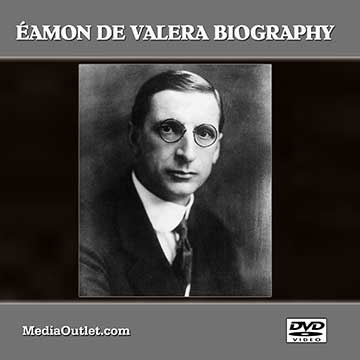
October 14, 1882: #BOTD: #HBD! Eamon De
Valera, Irish soldier, statesman and political leader, 3rd
President of Ireland (d. August 29, 1975) is #born at the Nursery
and Child's Hospital, Lexington Avenue, New York City, a home for
destitute orphans and abandoned children, the son of Catherine
Coll, who was originally from Bruree, County Limerick, and Juan
Vivion De Valera, described on the birth certificate as a Spanish
artist born in 1853. Some researchers have placed his father's
place of birth in Cuba, while others have suggested other
locations; according to Antonio Rivero Taravillo, he was born in
Seville, while Ronan Fanning has him born in the Basque Country.
His parents were reportedly married on September 18 1881 at St
Patrick's Church in Jersey City, New Jersey, but archivists have
not located any marriage certificate or any birth, baptismal, or
death certificate information for anyone called Juan Vivion De
Valera (nor for "de Valeros", an alternative spelling).
On De Valera's original birth certificate, his name is given as
George de Valero and his father is listed as Vivion de Valero.
Although he was known as Edward De Valera before 1901, a fresh
birth certificate was issued in 1910, in which his first name was
officially changed to Edward and his father's surname given as "De
Valera". As a child, he was known as "Eddie" or
"Eddy". According to Eamon's mother Catherine Coll, Juan
Vivion died in 1885, leaving Coll and her child in poor
circumstances. Eamon was taken to Ireland by his uncle Ned at the
age of two. When his mother remarried in the mid-1880s, he was not
brought back to live with her, but was reared by his grandmother,
Elizabeth Coll, her son Patrick and her daughter Hannie, in
Bruree, County Limerick. He was educated locally at Bruree
National School, County Limerick and C.B.S. Charleville, County
Cork. Aged sixteen, he won a scholarship. He was not successful in
enrolling at two colleges in Limerick, but was accepted at
Blackrock College, Dublin, at the instigation of his local curate.
He played rugby at Blackrock and Rockwell College, then for
Munster around 1905. He remained a lifelong devotee of rugby,
attending international matches even towards the end of his life
when he was nearly blind. At the end of his first year at
Blackrock College he was student of the year. He also won further
scholarships and exhibitions and in 1903 was appointed teacher of
mathematics at Rockwell College, County Tipperary. Eamon De
Valera's political career spanned over half a century, from 1917
to 1973; he served several terms as head of government and head of
state. He also led the introduction of the Constitution of
Ireland. Prior to De Valera's political career, he was a
Commandant at Boland's Mill during the 1916 Easter Rising, an
Irish revolution that eventually contributed to Irish
independence. He was arrested, sentenced to death but released for
a variety of reasons, including the public response to the British
execution of Rising leaders. He returned to Ireland after being
jailed in England and became one of the leading political figures
of the War of Independence. After the signing of the Anglo-Irish
Treaty, De Valera served as the political leader of Anti-Treaty
Sinn Fein until 1926, when he, along with many supporters, left
the party to set up Fianna Fail, a new political party which
abandoned the policy of abstentionism from Dail Eireann. From
there, De Valera went on to be at the forefront of Irish politics
until the turn of the 1960s. He took over as President of the
Executive Council from W. T. Cosgrave and later Taoiseach, with
the passing of Bunreacht Na hEireann (Irish constitution) in 1937.
He served as Taoiseach on 3 occasions; from 1937 to 1948, from
1951 to 1954 and finally from 1957 to 1959. He remains the longest
serving Taoiseach by total days served in the post. He resigned in
1959 upon his election as President of Ireland. By then, he had
been Leader of Fianna Fail for 33 years, and he, along with older
founding members, began to take a less prominent role relative to
newer ministers such as Jack Lynch, Charles Haughey and Neil
Blaney. He would serve as President from 1959 to 1973, two full
terms in office. De Valera's political beliefs evolved from
militant Irish republicanism to strong social, cultural and
economic conservatism. He has been characterised by a stern,
unbending, devious demeanour. His roles in the Civil War have also
portrayed him as a divisive figure in Irish history. Biographer
Tim Pat Coogan sees his time in power as being characterised by
economic and cultural stagnation, while Diarmaid Ferriter argues
that the stereotype of De Valera as an austere, cold and even
backward figure was largely manufactured in the 1960s and is
misguided. Eamon De Valera died of pneumonia and heart failure at
Linden Convalescent Home, Blackrock, Dublin, aged 92. His wife,
Sinead De Valera, four years his senior, had died the previous
January, on the eve of their 65th wedding anniversary. His body
lay in state at Dublin Castle and was given a full state funeral
on September 3 at St Mary's Pro-Cathedral, which was broadcast on
national television. Over 200,000 people reportedly lined the
three-mile funeral route from Dublin city centre to Glasnevin
Cemetery. He is buried in Glasnevin alongside his wife and son
Brian. On Sale @ 15% Off Discount Till Midnight PT!
https://store.earthstation1.com/eamon-de-valera-dvd-irish-civil-war-leader-and-president.html
Today's
EarthStation1.com 15% Off Commemorative Memorial Title: 150 Years
Of Photography Hal Holbrook + Bonus Title DVD Video Download
Today, October 14, 2025
October 14, 1884: Great Inventions:
Photography: The History Of Photography: Film Photography: -- The
first photographic film is patented when the American inventor
George Eastman receives a U.S. Government patent for his new
paper-strip photographic film. By September 4, 1888, Eastman
registered the trademark Kodak and received a patent for his Kodak
Black camera, the first popular camera designed, one that used a
roll of Eastman's paper-strip film. With it, the Kodak Black
camera took round pictures 6.4 cm (2.5 in) in diameter. The camera
was of the fixed focus type, and carried a roll of film enough for
100 exposures. Its invention practically marked the advent of
amateur photography, as before that time both apparatus and
processes were too burdensome to classify photography as
recreation. The roll film used in the first model of the Kodak
camera had a paper base but was soon superseded by a film with a
cellulose base, a practical transparent flexible film. The first
films had to be loaded into the camera and unloaded in the dark
room, but the film cartridge system with its protecting strip of
opaque paper made it possible to load and unload the camera in
ordinary light. The Kodak Developing Machine (1900) and its
simplified successor, the Kodak Film Tank, provided the means for
daylight development of film, making the dark room unnecessary for
any of the operations of amateur photography. The earlier types of
the Kodak cameras were of the box form and of fixed focus, and as
various sizes were added, devices for focusing the lenses were
incorporated. On Sale @ 15% Off Discount Till Midnight PT!
https://store.earthstation1.com/150-years-of-photography-the-photographic-camera-era-with-hal-holbr150.html
Today's
EarthStation1.com 15% Off Commemorative Memorial Title: Dwight D.
Eisenhower: In War And Peace DVD, Video Download, USB Drive
Today, October 14, 2025
October 14, 1890: #BOTD: #HBD! Dwight D.
Eisenhower, GCB, OM, RE, GCS, CCLH, KC, NPk, popularly known as
"Ike", American general, politician and statesman who
served as the 34th president of the United States from 1953 to
1961 (d. March 28, 1969) is #born Dwight David Eisenhower in
Denison, Texas. During World War II, he served as Supreme
Commander of the Allied Expeditionary Force in Europe, and
achieved the rare five-star rank of General of the Army. He was
responsible for planning and supervising the invasion of North
Africa in Operation Torch in 1942-1943 and the successful invasion
of Normandy in 1944-1945 from the Western Front. Eisenhower was
raised in Abilene, Kansas, in a large family of mostly
Pennsylvania Dutch ancestry. His family had a strong religious
background. His mother became a Jehovah's Witness. Eisenhower,
however, did not belong to any organized church until 1952. He
graduated from West Point in 1915 and later married Mamie Doud,
with whom he had two sons. During World War I, he was denied a
request to serve in Europe and instead commanded a unit that
trained tank crews. Following the war, he served under various
generals and was promoted to the rank of brigadier general in
1941. After the United States entered World War II, Eisenhower
oversaw the invasions of North Africa and Sicily before
supervising the invasions of France and Germany. After the war, he
served as Army Chief of Staff (1945-1948), as president of
Columbia University (1948-1953) and as the first Supreme Commander
of NATO (1951-1952). In 1952, Eisenhower entered the presidential
race as a Republican to block the isolationist foreign policies of
Senator Robert A. Taft; Taft opposed NATO and wanted no foreign
entanglements. Eisenhower won that election and the 1956 election
in landslides, both times defeating Adlai Stevenson II.
Eisenhower's main goals in office were to contain the spread of
communism and reduce federal deficits. In 1953, he threatened to
use nuclear weapons until China agreed to peace terms in the
Korean War. China did agree and an armistice resulted which
remains in effect. His New Look policy of nuclear deterrence
prioritized inexpensive nuclear weapons while reducing funding for
expensive Army divisions. He continued Harry S. Truman's policy of
recognizing Taiwan as the legitimate government of China, and he
won congressional approval of the Formosa Resolution. His
administration provided major aid to help the French fight off
Vietnamese Communists in the First Indochina War. After the French
left, he gave strong financial support to the new state of South
Vietnam. He supported regime-changing military coups in Iran and
Guatemala orchestrated by his own administration. During the Suez
Crisis of 1956, he condemned the Israeli, British, and French
invasion of Egypt, and he forced them to withdraw. He also
condemned the Soviet invasion during the Hungarian Revolution Of
1956 but took no action. After the Soviet Union launched Sputnik
in 1957, Eisenhower authorized the establishment of NASA, which
led to the Space Race. He deployed 15,000 soldiers during the 1958
Lebanon crisis. Near the end of his term, he failed to set up a
summit meeting with the Soviets when a U.S. spy plane was shot
down over the Soviet Union. He approved the Bay Of Pigs invasion,
which was left to John F. Kennedy to carry out. On the domestic
front, Eisenhower was a moderate conservative who continued New
Deal agencies and expanded Social Security. He covertly opposed
Joseph McCarthy and contributed to the end of McCarthyism by
openly invoking executive privilege. He signed the Civil Rights
Act of 1957 and sent Army troops to enforce federal court orders
which integrated schools in Little Rock, Arkansas. His largest
program was the Interstate Highway System. He promoted the
establishment of strong science education via the National Defense
Education Act. His two terms saw unprecedented economic prosperity
except for a minor recession in 1958. In his farewell address to
the nation, he expressed his concerns about the dangers of massive
military spending, particularly deficit spending and government
contracts to private military manufacturers, which he dubbed "the
military-industrial complex". Historical evaluations of his
presidency place him among the upper tier of American presidents.
Dwight D. Eisenhower died in the morning in Washington, D.C., of
congestive heart failure at Walter Reed Army Medical Center, at
age 78. The following day, his body was moved to the Washington
National Cathedral's Bethlehem Chapel, where he lay in repose for
28 hours. He was then transported to the United States Capitol,
where he lay in state in the Capitol Rotunda on March 30 and 31. A
state funeral service was conducted at the Washington National
Cathedral on March 31. The president and First Lady, Richard and
Pat Nixon, attended, as did former president Lyndon Johnson. Also
among the 2,000 invited guests were U.N. Secretary General U Thant
and 191 foreign delegates from 78 countries, including 10 foreign
heads of state and government. Notable guests included President
Charles de Gaulle of France, who was in the United States for the
first time since the state funeral of John F. Kennedy, Chancellor
Kurt-Georg Kiesinger of West Germany, King Baudouin of Belgium and
Shah Mohammad Reza Pahlavi of Iran. The service included the
singing of Faure's The Palms, and the playing of the hymn Onward,
Christian Soldiers. That evening, Eisenhower's body was placed
onto a special funeral train for its journey from the nation's
capital through seven states to his hometown of Abilene, Kansas.
First incorporated into President Abraham Lincoln's funeral in
1865, a funeral train would not be part of a U.S. state funeral
again until 2018. Eisenhower is buried inside The Place Of
Meditation, the chapel on the grounds of the Eisenhower
Presidential Center in Abilene. As requested, he was buried in a
Government Issue casket, wearing his World War II uniform,
decorated with Army Distinguished Service Medal with three oak
leaf clusters, Navy Distinguished Service Medal, and the Legion of
Merit. Buried alongside Eisenhower are his son Doud, who died at
age 3 in 1921, and wife Mamie, who died in 1979. President Richard
Nixon eulogized Eisenhower in 1969, saying: "Some men are
considered great because they lead great armies or they lead
powerful nations. For eight years now, Dwight Eisenhower has
neither commanded an army nor led a nation; and yet he remained
through his final days the world's most admired and respected man,
truly the first citizen of the world." On Sale @ 15% Off
Discount Till Midnight PT!
https://store.earthstation1.com/dwight-d-eisenhower-documentaries-dual-layer-dvd.html
Today's
EarthStation1.com 15% Off Commemorative Memorial Title: The Deming
Of America: W. Edwards Deming DVD MP4 Download USB Drive
Today, October 14, 2025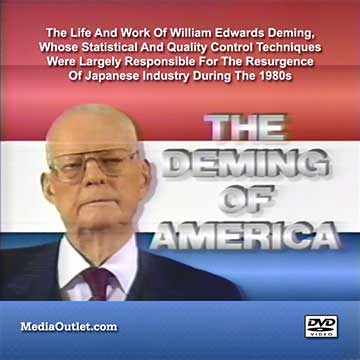
October 14, 1900: #BOTD: W. Edwards
Deming, American statistician, author, academic, engineer,
professor, lecturer and management consultant (d. December 20,
1993) is #born William Edwards DemingSioux City, Iowa. Educated
initially as an electrical engineer and later specializing in
mathematical physics, William Edwards Deming helped develop the
sampling techniques still used by the U.S. Department of the
Census and the Bureau of Labor Statistics. In his book, The New
Economics for Industry, Government, and Education, Deming
championed the work of Walter Shewhart, including statistical
process control, operational definitions, and what Deming called
the "Shewhart Cycle" which had evolved into PDSA
(Plan-Do-Study-Act). Deming is best known for his work in Japan
after WWII, particularly his work with the leaders of Japanese
industry. That work began in August 1950 at the Hakone Convention
Center in Tokyo when Deming delivered a speech on what he called
"Statistical Product Quality Administration". Many in
Japan credit Deming as one of the inspirations for what has become
known as the post-war Japanese economic miracle of 1950 to 1960,
when Japan rose from the ashes of war on the road to becoming the
second largest economy in the world through processes partially
influenced by the ideas Deming taught: 1) Better design of
products to improve service; 2) Higher level of uniform product
quality; 3) Improvement of product testing in the workplace and in
research centers; and 4) Greater sales through side [global]
markets. Deming is best known in the United States for his 14
Points (Out of the Crisis, by W. Edwards Deming, preface) and his
system of thought he called the "System of Profound
Knowledge". The system includes four components or "lenses"
through which to view the world simultaneously: 1) Appreciating a
system; 2) Understanding variation; 3) Psychology; and 4)
Epistemology ("logical discourse"), the theory of
knowledge which studies the nature of knowledge, justification,
and the rationality of belief. Deming made a significant
contribution to Japan' reputation for innovative, high-quality
products, and for its economic power. He is regarded as having had
more impact on Japanese manufacturing and business than any other
individual not of Japanese heritage. Despite being honored in
Japan in 1951 with the establishment of the Deming Prize, he was
only just beginning to win widespread recognition in the U.S. at
the time of his death in 1993. President Ronald Reagan awarded him
the National Medal of Technology in 1987. The following year, the
National Academy of Sciences gave Deming the Distinguished Career
in Science award. W. Edwards Deming died in his sleep at the age
of 93 in his Washington home from cancer. When asked, toward the
end of his life, how he would wish to be remembered in the U.S.,
he replied, "I probably won't even be remembered." After
a pause, he added, "Well, maybe ... as someone who spent his
life trying to keep America from committing suicide." He is
buried at Saint Columbas Episcopal Church Columbarium in
Tenleytown, Washington, D.C.. On Sale @ 15% Off Discount Till
Midnight PT!
https://store.earthstation1.com/the-deming-of-america-dvd-engineer-w-edwards-deming.html
Today's
EarthStation1.com 15% Off Commemorative Memorial Title: The
Indomitable Teddy Roosevelt w/ George C Scott DVD, Download, USB
Today, October 14, 2025
October 14, 1912: United States
Presidential Assassination Attempts And Plots: The Attempted
Assassination Of Theodore Roosevelt: -- Former President Theodore
Roosevelt is shot with a .38-caliber Colt Police Positive Special
revolver while campaigning in Milwaukee by John Flammang Schrank,
a Bavarian-born saloonkeeper of New York who had been stalking him
for weeks. Roosevelt was saved by his thick overcoat, a metal
glasses case and the 50-page text of his campaign speech folded
over twice in his breast pocket, all of which slowed the bullet.
Schrank was immediately disarmed, captured and might have been
lynched had Roosevelt not shouted for Schrank to remain unharmed.
Although wounded, Roosevelt insisted on making the speech with the
bullet lodged in his chest, and did not go to the hospital until
the meeting ended. At Schrank's trial, the would-be assassin
claimed that William McKinley had visited him in a dream, and told
him to avenge his assassination by killing Roosevelt. He was found
legally insane, and was institutionalized until his death in 1943.
Roosevelt, a rugged outdoorsman, fully recovered in two weeks. On
Sale @ 15% Off Discount Till Midnight PT!
https://store.earthstation1.com/the-indomitable-teddy-roosevelt-george-c-scott-john-philip-sousa-dvd.html
Today's
EarthStation1.com 15% Off Commemorative Memorial Title: The Road
To War: Years Between WWI & WWII TV Series DVD, Download, USB
Today, October 14, 2025
October 14, 1933: The Interwar Period
(The Aftermath Of World War I, The Interbellum, Between The Wars):
The Road To War: The Withdrawal Of Germany From The League Of
Nations (French: Societe Des Nations) (LN, LoN, LON, SdN, SDN): --
Nazi Germany announces its withdrawal from the League Of Nations,
and states it will take no further part in the Geneva Disarmament
Conference. Five days later, on October 19, 1933, with a curt
letter sent some nine months after Adolf Hitler was appointed
chancellor of Germany, Hitler directs German Foreign Minister
Konstantin Freiherr Von Neurath to send a letter to the League Of
Nations secretary-general, Joseph Avenol, to officially inform him
of Germany's withdrawal from the League Of Nations. The entire
text of the letter reads (verbatim and sic): "Berlin, the 19.
October 1933. Mr. Secretary General ! On behalf of the German
Government, I have the honor to inform you that Germany hereby
declares its withdrawal from the League Of Nations in accordance
with Article 1 Paragraph 3 of the Statute. Please accept, Mr.
Secretary General, the expression of my highest esteem. Freiherr
Von Neurath". The ostensible reason given by the German
government for withdrawing from the League was the refusal of the
Western powers to acquiesce in Germany's demands for military
parity, claiming its disarmament clauses were unfair as they
applied only to Germany. Germany's departure from the
international organization was followed by its massive military
buildup, undertaken in violation of international agreements;
renunciation of the Locarno Pact (1936); seizure of Austria
(1938); and annexation of the Czechoslovak provinces of Bohemia
and Moravia (March 1939). These actions culminated in the German
attack on Poland of September 1, 1939, and the outbreak of World
War II. The letter is from the archives of the League Of Nations,
which are preserved at the United Nations Office in Geneva. They
were inscribed on the UNESCO Memory of the World register in 2010.
On Sale @ 15% Off Discount Till Midnight PT!
https://store.earthstation1.com/the-road-to-war-dvd-set-all-8-tv-shows-4-dis84.html
Today's
EarthStation1.com 15% Off Commemorative Memorial Title: Causes Of
World War II Documentaries DVD, Video Download, USB Drive
Today, October 14, 2025
October 14, 1933: The Interwar Period
(The Aftermath Of World War I, The Interbellum, Between The Wars):
The Road To War: The Withdrawal Of Germany From The World
Disarmament Conference (The Conference For The Reduction And
Limitation Of Armaments, The Geneva Conference): -- On the same
day that Nazi Germany announced its withdrawal from the League Of
Nations, Nazi Germany announces its withdrawal from The World
Disarmament Conference, an international conference of states held
in Geneva, Switzerland, between February 1932 and November 1934 to
accomplish disarmament in accordance with the Covenant of the
League of Nations. It was attended by 61 states, most of which
were members of the League of Nations, but the USSR and the United
States also attended. The conference symbolised global
co-operation to a combined goal of limiting arms, but it is
generally perceived as a failure because of the onset of the
Second World War five years later and the withdrawal of Nazi
Germany from both the conference and the League. Adolf Hitler had
come to power in Germany in January of that year,.The military
superiority of Germany was a defining element of Hitler's ideology
and foreign policy, which made the idea of disarmament
unacceptable. As soon as Hitler rose to power, he began the
process of rearming Germany, clearly defying both the Treaty of
Versailles and the objective of the Disarmament Conference. Hitler
drew on the unwillingness of other countries to disarm as a
justification that Germany should not be forced to do the same.
Consequently, when Hitler withdrew Germany from the League of
Nations and the Treaty of Versailles, the French were unwilling to
disarm. Depite a British Foreign Office statement that "the
failure of the Disarmament Conference would have incalculable
consequences for Europe and the League [of Nations]", the
conference was ultimately adjourned in November 1934. On Sale @
15% Off Discount Till Midnight PT!
https://store.earthstation1.com/causes-of-world-war-ii-documentaries-4-dvd-se4.html
Today's
EarthStation1.com 15% Off Commemorative Memorial Title: Start
Engines + 50 Years: The US Eighth Army Air Force + Bonus MP4 DVD
Today, October 14, 2025
October 14, 1943: The European Civil War:
World War II: The Second European War (The European Theater Of
World War II): Aviation: Military Aviation: Air Warfare Of World
War II: Strategic Bombing During World War II: European Air
Operations During The Battle Of Europe: The Combined Bomber
Offensive (CBO): Operation Pointblank: The Second Raid On
Schweinfurt (The Schweinfurt Raid, Black Thursday): -- The
American Eighth Air Force loses 60 of 291 B-17 Flying Fortress
heavy bombers during the second mass-daylight air raid on the
Schweinfurt ball bearing factories in western Nazi Germany. The
Second Schweinfurt Raid was a World War II strategic bombing raid
conducted by bombers of the American Eighth Air Force on German
ball bearing factories in order to reduce production of these
vital parts for all manner of war machines. As the second attack
on the factories at Schweinfurt, it had been planned as a
follow-up raid, after being postponed to rebuild heavy American
bomber losses, after American wartime intelligence claimed the
first Schweinfurt-Regensburg mission in August had reduced bearing
production by 34 percent. As the squadrons were rebuilt, plans for
the return mission were modified based on the lessons learned in
the First Raid On Schweinfurt. Planners added additional fighter
escorts to cover the outward and return legs of the operation, and
sent the entire force against Schweinfurt alone, instead of
splitting the force between two targets as had been done in the
prior raid. Despite these tactical modifications, a series of
minor mishaps combined with the ever-increasing efficiency of the
German anti-aircraft effort proved to be devastating. Of the 291
B-17 Flying Fortresses sent on the mission, 60 were lost outright,
another 17 damaged so heavily that they had to be scrapped, and
another 121 had varying degrees of battle damage. Outright losses
represented over 26% of the attacking force, far above the less
than 10% loss-per-mission levels considered acceptable. Losses in
aircrew were equally heavy, with 650 men lost of 2,900, 22 percent
of the bomber crews. The American Official History of the Army Air
Forces in the Second World War acknowledged losses had been so
great that the USAAF would not return to the target for four
months, as the Eighth Air Force had for the time being lost air
superiority over Germany. The operation was a grand failure. The
bomber formations were left exposed to unrelenting attacks by
German fighters, and the improper preparations for the creation of
reserves in the summer of 1943 meant that such costly operations
could not be sustained. An escort of 24 squadrons of Spitfires
equipped with drop tanks was provided on the first and last leg of
the mission. The strategy of the Allied air forces was flawed.
Arthur Harris, Air Officer Commanding RAF Bomber Command
questioned the intelligence that claimed ball bearings to be vital
to the German war economy. Harris refused to cooperate with the
Americans, believing ball bearing targets to be a "panacea".
Post-war analysis has shown Harris's objections to be correct. The
Germans had built up enormous reserves of ball bearings and were
receiving supplies from all over Europe, particularly Italy,
Sweden and Switzerland. The operation against these industries
would, even if successful, have achieved little. By 1945, the
Germans had assembled more reserves than ever. On Sale @ 15% Off
Discount Till Midnight PT!
https://store.earthstation1.com/start-engines-plus-50-years-8th-airforce-historical-society-508.html
Today's
EarthStation1.com 15% Off Commemorative Memorial Title: The Last
Chapter: The End Of Jewish Life In Poland DVD, MP4, USB Drive
Today, October 14, 2025
October 14, 1943: The European Civil War:
World War II: The Second European War (The European Theater Of
World War II): The Holocaust (Shoah): The Holocaust In Poland::
The Sobibor Extermination Camp Uprising: -- Prisoners at the Nazi
German Sobibor extermination camp in Poland revolt against the
Germans, killing twelve SS guards, and wounding many more. The
camp ceased operations as a result. About 300 of the Sobibor
Camp's 600 prisoners escape, of whom 58 are known to have survived
the war. The plan for the revolt involved two phases. In the first
phase, teams of prisoners were to discreetly assassinate each of
the SS officers. In the second phase, all 600 prisoners would
assemble for evening roll call and walk to freedom out the front
gate. However, the plan was disrupted after only 12 of the SS
officers had been killed. As a result, the prisoners had to escape
by climbing over barbed wire fences and running through a mine
field under heavy machine gun fire. After the revolt, the Nazis
demolished the camp and planted it over with pine trees. The site
was neglected in the first decades after World War Two, and the
camp itself had little presence in either popular or scholarly
accounts of the Holocaust. It became better known after it was
portrayed in the United States TV miniseries Holocaust (1978) and
the British TV film Escape from Sobibor (1987). After the fall of
the Soviet Union, the Sobibor Museum opened at the site, and
archaeologists began excavations which continue as of 2020. The
first photographs of the camp in operation were published in 2020
as part of the Sobibor perpetrator album. On Sale @ 15% Off
Discount Till Midnight PT!
https://store.earthstation1.com/the-last-chapter-the-end-of-jewish-life-in-poland-dvd-mp3-us3.html
Today's
EarthStation1.com 15% Off Commemorative Memorial Title: Erwin
Rommel Documentaries Set DVD, Video Download, USB Flash Drive
Today, October 14, 2025
October 14, 1944: #DOTD: #RIP: Erwin
Rommel, popularly known as the Desert Fox, German General, Field
Marshal and military theorist, Pour le Merite recipient, Germany's
highest military award (b. November 15, 1891), linked to the
failed July 20, 1944 plot to assassinate Hitler, is given a choice
by Hitler between committing suicide, in return for assurances
that his reputation would remain intact and that his family would
not be persecuted following his death, or facing a trial that
would result in his disgrace and execution; he chose the former,
and committed suicide at age 52 near Ulm, Germany using a cyanide
pill. Because of Rommel's status as a national hero, Hitler
desired to eliminate him quietly instead of immediately executing
him, as many other plotters were. Rommel was given a state
funeral, and it was announced that he had succumbed to his
injuries from the strafing of his staff car in Normandy. He is
buried at the Friedhof Herrlingen in Herrlingen,
Baden-Wurttemberg, Germany. Field Marshal Erwin Rommel was born
Johannes Erwin Eugen Rommel at Heidenheim, in Wurttemberg,
Germany. He served as field marshal in the Wehrmacht (armed
forces) of Nazi Germany during World War II, as well as serving in
the Reichswehr of the Weimar Republic, and the army of Imperial
Germany. Rommel was a highly decorated officer in World War I and
was awarded the Pour le Merite, Germany's highest military
award,for his actions on the Italian Front. In 1937 he published
his classic book on military tactics, Infantry Attacks, drawing on
his experiences in that war. In World War II, he distinguished
himself as the commander of the 7th Panzer Division during the
1940 Battle Of France. His early victories and leadership of
German and Italian forces in the North African campaign
established his reputation as one of the ablest tank commanders of
the war, and earned him the nickname der Wustenfuchs, "the
Desert Fox". However, in 1943, he was defeated at El Alamein
by the British under General Montgomery. Among his British
adversaries he had a reputation for chivalry, and his phrase "war
without hate" has been used to describe the North African
campaign. A number of historians have since rejected the phrase as
myth and uncovered numerous examples of war crimes and abuses both
towards enemy soldiers and native populations in Africa during the
conflict. Other historians note that there is no clear evidence
Rommel was involved or aware of these crimes (although Caron and
Mullner point out that his military successes allowed these crimes
to happen) with some pointing out that the war in the desert, as
fought by Rommel and his opponents, still came as close to a clean
fight as there was in World War II. He later commanded the German
forces opposing the Allied cross-channel invasion of Normandy in
June 1944. A number of historians connect Rommel himself with war
crimes, although this is not the opinion of the majority. With the
Nazis gaining power in Germany, Rommel gradually came to accept
the new regime, with historians giving different accounts on the
specific period and his motivations. He is generally considered a
supporter and close friend of Adolf Hitler, at least until near
the end of the war, if not necessarily sympathetic to the party
and the paramilitary forces associated with it. His stance towards
Nazi ideology and his level of knowledge of the Holocaust remain
matters of debate among scholars. Rommel has become a
larger-than-life figure in both Allied and Nazi propaganda, and in
postwar popular culture, with numerous authors considering him an
apolitical, brilliant commander and a victim of the Third Reich,
although this assessment is contested by other authors as the
Rommel myth. Rommel's reputation for conducting a clean war was
used in the interest of the West German rearmament and
reconciliation between the former enemies - the United Kingdom and
the United States on one side and the new Federal Republic of
Germany on the other. Several of Rommel's former subordinates,
notably his Chief Of Staff Hans Speidel, played key roles in
German rearmament and integration into NATO in the postwar era.
The German Army's largest military base, the Field Marshal Rommel
Barracks, Augustdorf, is named in his honour. On Sale @ 15% Off
Discount Till Midnight PT!
https://store.earthstation1.com/rommel-dvd-field-marshal-erwin-dual-layer-wwii-documentaries.html
Today's
EarthStation1.com 15% Off Commemorative Memorial Title: The X
Planes TV Documentary Series DVD, MP4, USB Drive
Today, October 14, 2025
October 14, 1947: Aviation: The History
Of Aviation: Flight Airspeed Records: Breaking The Sound Barrier:
Chuck Yeager And The Mach 1 Flight Of The Bell XS-1 (The Bell X-1,
The Bell Model 44, Glamorous Glennis): -- Captain Chuck Yeager of
the United States Air Force flies a Bell X-1 rocket-powered
experimental aircraft, the Glamorous Glennis, faster than the
speed of sound at Mach 1.06 (700 miles per hour (1,100 km/h; 610
kn) at an altitude of 45,000 feet (13,700 m) over the Rogers Dry
Lake in the Mojave Desert of Southern California, and becomes the
first pilot and the first airplane to do so in level flight.
Yeager was a Second World War fighter ace in the European Theater,
and he remained in the Air Force after the war, becoming a test
pilot at Muroc Army Air Field (now Edwards Air Force Base),
following graduation from Air Materiel Command Flight Performance
School (Class 46C). After Bell Aircraft test pilot Chalmers
"Slick" Goodlin demanded 150K USD (over 1.7M USD in
2020) to break the sound "barrier," the USAAF selected
Yeager to fly the rocket-powered Bell XS-1 in a NACA program to
research high-speed flight. Such was the difficulty in this task
that the answer to many of the inherent challenges was along the
lines of "Yeager better have paid-up insurance." Two
nights before the scheduled date for the flight, Yeager broke two
ribs when he fell from a horse. He was worried that the injury
would remove him from the mission and reported that he went to a
civilian doctor in nearby Rosamond, who taped his ribs. Yeager
told only his wife, as well as friend and fellow project pilot
Jack Ridley, about the accident. On the day of the flight, Yeager
was in such pain that he could not seal the X-1's hatch by
himself. Ridley rigged up a device, using the end of a broom
handle as an extra lever, to allow Yeager to seal the hatch. The
success of the mission was not announced to the public until June
1948. Yeager was awarded the Mackay Trophy and the Collier Trophy
in 1948 for his mach-transcending flight, and the Harmon
International Trophy in 1954. The X-1 he flew that day was later
put on permanent display at the Smithsonian Institution's National
Air and Space Museum. On Sale @ 15% Off Discount Till Midnight PT!
https://store.earthstation1.com/the-x-planes-tv-documentary-series-dvd-mp4-usb-driv4.html
Today's
EarthStation1.com 15% Off Commemorative Memorial Title: The
Missiles Of October (1974) Cuban Missile Crisis DVD, MP4, USB
Today, October 14, 2025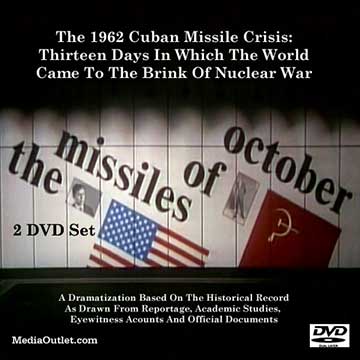
October 14, 1962: Cuba: The History Of
Cuba: The Aftermath Of World War II: The Cold War: The Cold War
(1962-1979): The Cuban Cold War: The Cuban Missile Crisis: -- A
U.S. Air Force U-2 reconnaissance plane and its pilot Major
Richard Heyser flies over the island of Cuba and takes 928
pictures, including photographs of Soviet medium range R-12 Dvina
theatre ballistic missiles (NATO reporting name: SS-4 Sandal)
being installed and erected at San Cristobal, Pinar del Rio
Province (now in Artemisa Province), in western Cuba, sparking The
Cuban Missile Crisis. Within 24 hours, the CIA's National
Photographic Interpretation Center (NPIC) reviewed the U-2
photographs and identified objects that they interpreted as medium
range ballistic missiles. This identification was made, in part,
on the strength of reporting provided by Oleg Penkovsky, a double
agent in the GRU working for CIA and MI6. Although he provided no
direct reports of the Soviet missile deployments to Cuba,
technical and doctrinal details of Soviet missile regiments that
had been provided by Penkovsky in the months and years prior to
the Crisis helped NPIC analysts correctly identify the missiles on
U-2 imagery. The CIA then notified the Department of State and at
8:30 pm EDT, Bundy chose to wait until the next morning to tell
the President. McNamara was briefed at midnight. On Sale @ 15% Off
Discount Till Midnight PT!
https://store.earthstation1.com/the-missiles-of-october-1974-cuban-missile-crisis-docud1974.html
Today's
EarthStation1.com 15% Off Commemorative Memorial Title: Nikita
Khrushchev Biography Documentary Set MP4 Video Download DVD
Today, October 14, 2025
October 14, 1964: The Premiership Of
Nikita Khrushchev: The 1964 Kremlin Coup: -- On the second
anniversary of The Cuban Missile Crisis he precipitated, Soviet
Russia's leader Nikita Khrushchev is deposed as First Secretary of
the Soviet Communist Party when the Presidium of the Supreme
Soviet and the Central Committee each voted to accept Khrushchev's
"voluntary" request to retire from his offices for
reasons of "advanced age and ill health." Leonid
Brezhnev was elected First Secretary (later General Secretary),
while Alexei Kosygin succeeded Khrushchev as premier. Beginning in
March 1964, Supreme Soviet presidium chairman and nominal head of
state Leonid Brezhnev began discussing Khrushchev's removal with
his colleagues, due to Khrushchev's mercurial behavior on the
world stage, in foreign affairs, domestic politics and political
policy. While Brezhnev considered having Khrushchev arrested as he
returned from a trip to Scandinavia in June, he instead spent time
persuading members of the Central Committee to support the ousting
of Khrushchev, remembering how crucial the Committee's support had
been to Khrushchev in defeating the Anti-Party Group plot.
Brezhnev was given ample time for his conspiracy; Khrushchev was
absent from Moscow for a total of five months between January and
September 1964. The conspirators, led by Brezhnev, First Deputy
Premier Alexander Shelepin, and KGB chairman Vladimir Semichastny,
struck in October 1964, while Khrushchev was on vacation at
Pitsunda, Abkhaz ASSR with his close ally Anastas Mikoyan. On
October 12, Brezhnev called Khrushchev to notify him of a special
Presidium meeting to be held the following day, ostensibly on the
subject of agriculture. Even though Khrushchev suspected the real
reason for the meeting, he flew to Moscow, accompanied by the head
of the Georgian KGB, General Aleksi Inauri, but otherwise taking
no precautions. Khrushchev arrived at the VIP hall of Vnukovo
Airport; KGB chairman Vladimir Semichastny waited for him there,
flanked by KGB security guards. Semichastny informed Khrushchev of
his ouster and told him not to resist. Khrushchev did not resist,
and the plotters' coup went off smoothly; Khrushchev felt betrayed
by Semichastny, as he considered him a friend and ally until that
very moment, not suspecting that he had joined his enemies within
the Party. Khrushchev was then taken to the Kremlin, to be
verbally attacked by Brezhnev, Suslov and Shelepin. He had no
stomach for a fight, and put up little resistance. Semichastny was
careful not to create the appearance of a coup: "I didn't
even close the Kremlin to visitors. People were strolling around
outside, while in the room the Presidium was meeting. I deployed
my men around the Kremlin. Everything that was necessary was done.
Brezhnev and Shelepin were nervous. I told them: Let's not do
anything that isn't necessary. Let's not create the appearance of
a coup." That night, after his ouster, Khrushchev called his
friend and Presidium colleague Anastas Mikoyan, and told him "I'm
old and tired. Let them cope by themselves. I've done the main
thing. Could anyone have dreamed of telling Stalin that he didn't
suit us anymore and suggesting he retire? Not even a wet spot
would have remained where we had been standing. Now everything is
different. The fear is gone, and we can talk as equals. That's my
contribution. I won't put up a fight." Khrushchev was granted
a pension of 500 rubles per month and was assured that his house
and dacha were his for life. Following his removal from power, he
fell into deep depression. He received few visitors, especially
since his security guards kept track of all guests and reported
their comings and goings. In the autumn of 1965, he and his wife
were ordered to leave their house and dacha to move to an
apartment and to a smaller dacha in Petrovo-Dalneye. His pension
was reduced to 400 rubles per month, though his retirement
remained comfortable by Soviet standards. The depression
continued, and his doctor prescribed sleeping pills and
tranquillizers. One of his grandsons was asked what the ex-premier
was doing in retirement, and the boy replied, "Grandfather
cries." He was made a non-person to such an extent that the
thirty-volume Great Soviet Encyclopedia omitted his name from the
list of prominent political commissars during the Great Patriotic
War. As the new rulers made known their conservatism in artistic
matters, Khrushchev came to be more favourably viewed by artists
and writers, some of whom visited him. One visitor whom Khrushchev
regretted not seeing was former U.S. Vice President Nixon, then in
his "wilderness years" before his election to the
presidency, who went to Khrushchev's Moscow apartment while the
former premier was at his dacha. On Sale @ 15% Off Discount Till
Midnight PT!
https://store.earthstation1.com/nikita-khrushchev-documentaries-dvd.html
Today's
EarthStation1.com 15% Off Commemorative Memorial Title: King: A
Filmed Record: Montgomery To Memphis DVD, Download, USB Drive
Today, October 14, 2025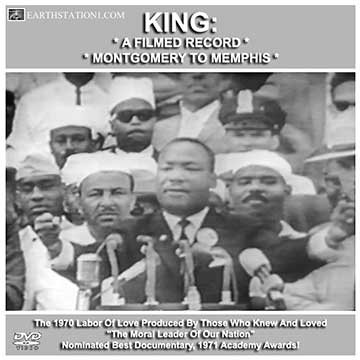
October 14, 1964: Civil Rights Movements:
The American Civil Rights Movement (1954-1968): Martin Luther
King, Jr.: The Nobel Peace Prize: The 1964 Nobel Peace Prize: --
Civil rights leader Martin Luther King, Jr., became the youngest
recipient of the Nobel Peace Prize, which was awarded to him "for
his non-violent struggle for civil rights for the Afro-American
population." He donated the 54K USD in prize money to the
civil rights movement. King had been inspired by Gandhi and his
success with nonviolent activism, and as a theology student, King
described Gandhi as being one of the "individuals who greatly
reveal the working of the Spirit of God". King had "for
a long time ... wanted to take a trip to India." With
assistance from Harris Wofford, the American Friends Service
Committee, and other supporters, he was able to fund the journey
in April 1959. The trip to India affected King, deepening his
understanding of nonviolent resistance and his commitment to
America's struggle for civil rights. In a radio address made
during his final evening in India, King reflected, "Since
being in India, I am more convinced than ever before that the
method of nonviolent resistance is the most potent weapon
available to oppressed people in their struggle for justice and
human dignity." King's admiration of Gandhi's nonviolence was
underscored when he held Gandhi up as his example when receiving
the Nobel Peace Prize in 1964, hailing the "successful
precedent" of using nonviolence "in a magnificent way by
Mohandas K. Gandhi to challenge the might of the British Empire
... He struggled only with the weapons of truth, soul force,
non-injury and courage." On Sale @ 15% Off Discount Till
Midnight PT!
https://store.earthstation1.com/king-a-filmed-record--montgomery-to-memphis-dvd.html
Today's
EarthStation1.com 15% Off Commemorative Memorial Title: John
Cleese's First Farewell Performance (1988) MP4 Video Download DVD
Today, October 14, 2025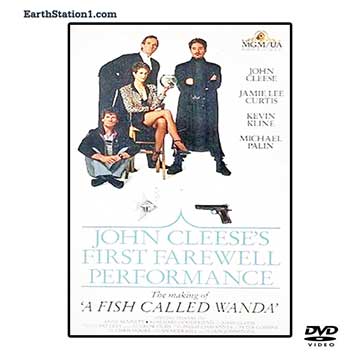
October 14, 1988: Aesthetics: Performing
Arts: Premieres: Film Premieres: American Film Premieres: -- A
Fish Called Wanda, a heist comedy film directed by Charles
Crichton and written by Crichton and John Cleese, the
highest-grossing British film of all time and the number one
rental video in the US in 1989, premieres in the UK; it had made
is World Premiere in New York City on July 7, 1988, and in Los
Angeles on July 13, 1988, and was released theatrically in the
United States by Metro-Goldwyn-Mayer on July 15, 1988. Six weeks
after its theatrical release, it reached number one at the box
office there. It eventually grossed 62.5M USD in the United States
and Canada, becoming the highest-grossing British film of all time
with a gross of 12 million PS. Outside of the US (including the
UK), it grossed 126.1M USD, for a worldwide total of 188.6M USD.
It was the number one rental video in the US in 1989. A Fish
Called Wanda stars Cleese, Jamie Lee Curtis, Kevin Kline, and
Michael Palin. The film follows a gang of diamond thieves who
double-cross one another to recover stolen diamonds hidden by
their jailed leader. His barrister becomes a central figure - and
jealousies rage - as femme fatale Wanda seduces him to locate the
loot. It received three nominations at the 61st Academy Awards:
Best Director, Best Original Screenplay, and Best Supporting Actor
for Kline, which he'd go on to win. A spiritual sequel, Fierce
Creatures, was released in 1997. The British Film Institute ranked
A Fish Called Wanda the 39th-greatest British film of the 20th
century. During the initial run of the film, a Danish audiologist
named Ole Bentzen died while laughing during a screening, which
led newspapers to report that he had died from laughter. The
official cause of death was heart fibrillation, which may have
been caused by an increased heart rate due to extended laughter.
Cleese considered using the event for publicity, but ultimately
decided it was in too bad taste. On Sale @ 15% Off Discount Till
Midnight PT!
https://store.earthstation1.com/john-cleeses-first-farewell-performance-1988-mp4-video-download-dvd.html
Today's
EarthStation1.com #OnThisDay Commemorative Memorial Title: TV
Commercials: The Classics Vol. 1 DVD, Video Download, USB Drive
Today, October 14, 2025 October 14: National Dessert Day: -- An
day of indulgence, celebrated by way of the local bakery,
grandma's house, chocolate shop or your grocer's freezer! Desserts
include candies, pies, ice cream, fruits, cookies, pastries,
cobblers, and donuts, too. The available ingredients affect the
range of desserts made in each region. The very first desserts
required minimal effort or preparation since ancient cultures were
more focused on the nutrition in foods to survive. Over the years,
desserts have changed from natural candies and nuts to complex
souffles and multi-layered cakes. In modern culture, there are
many more options available in desserts. Throughout the year, we
see seasonal delights. As we near the holiday season, the flavors
change. For some, the taste of gingerbread or fruitcake may come
to mind. Others will pull out recipes handed down for generations.
Pecan, pumpkin, and apple pies come to mind. Other rich desserts
round out the dessert table, too. Flan, tarts, and everything with
maple glaze. This is an excellent day to order dessert first!
Whether you go out to your favorite bakery or whip up something
delicious at home, share your celebrations with others. Give a
shout out to your favorite baker or share your go-to recipe.
What's your favorite dessert? Pie, cake, or something in between?
https://store.earthstation1.com/tv-commercials-the-classics-vol-1-dv1.html
October 14: National Dessert Day: -- An
day of indulgence, celebrated by way of the local bakery,
grandma's house, chocolate shop or your grocer's freezer! Desserts
include candies, pies, ice cream, fruits, cookies, pastries,
cobblers, and donuts, too. The available ingredients affect the
range of desserts made in each region. The very first desserts
required minimal effort or preparation since ancient cultures were
more focused on the nutrition in foods to survive. Over the years,
desserts have changed from natural candies and nuts to complex
souffles and multi-layered cakes. In modern culture, there are
many more options available in desserts. Throughout the year, we
see seasonal delights. As we near the holiday season, the flavors
change. For some, the taste of gingerbread or fruitcake may come
to mind. Others will pull out recipes handed down for generations.
Pecan, pumpkin, and apple pies come to mind. Other rich desserts
round out the dessert table, too. Flan, tarts, and everything with
maple glaze. This is an excellent day to order dessert first!
Whether you go out to your favorite bakery or whip up something
delicious at home, share your celebrations with others. Give a
shout out to your favorite baker or share your go-to recipe.
What's your favorite dessert? Pie, cake, or something in between?
https://store.earthstation1.com/tv-commercials-the-classics-vol-1-dv1.html
Today's
EarthStation1.com #OnThisDay Commemorative Memorial Title: Groucho
Marx & The Marx Bros OTR Radio Show MP3 Set DVD, Download, USB
Today, October 14, 2025October 14: National Real Sugar Day: --
Today we celebrate the people who harvest sugar crops and learn
about it's origins. We also learn how to balance a healthy diet,
while enjoying enjoy food made with real sugar. Today we celebrate
the gold standard of sweetness. In a March 2021 survey, 1,500 U.S.
consumers were asked to name any ingredients that makes food or
beverages more enjoyable to eat or drink. Of course, sugar came in
as the number one ingredient. Not only does real sugar provide our
food with amazing flavor, aroma, color, and texture, it is also
available to anyone who wants to make their life a little sweeter.
The real sugar we stock in our pantries and use in many of our
favorite recipes is grown by sugar beet and sugar cane farmers
across the United States. Sugar is a simple carbohydrate that
provides energy when you need it. In fact, glucose is the building
block of most carbohydrates and is a key fuel source for the body.
In addition, real sugar is essential for the brain, muscles, and
other organs to property function.
https://store.earthstation1.com/groucho-marx-and-marx-brothers-mp3-dvd-all-known-radio-show3.html
Today's
EarthStation1.com #OnThisDay Commemorative Memorial Title: Adlai
Stevenson: The Man From Libertyville DVD, Download, USB Drive
Today, October 14, 2025October 14: Be Bald And Be Free Day: --
Today we're here to show you how to celebrate the day in style!
There are millions of people who are affected by baldness, either
due to natural causes or medical treatments, which is why this day
is dedicated to the bald and the beautiful. Shaving heads and
beards began a lot earlier than one might think. The early men
from the Stone Age used sharpened clamshells and tweezers to shave
or pluck out hair. In ancient Rome and Egypt, shaving heads was
common amongst priests and also the common folk due to extremely
hot climates. Egyptians are said to have developed shaving tools
made of gold and copper. In the late 1950s, shaved heads started
becoming a trend. Bald men were seen as more virile, confident,
tough, and disciplined. Many actors, politicians, musicians, and
sports stars adopted the bald look. In the 1990s, the shaved head
style was at its peak with people like Michael Jordan, Evander
Holyfield, and Bruce Willis further popularizing the trend. Since
people battling cancer lose their hair due to radiation and
chemotherapy, people began shaving their heads, either as a way to
show support for the people battling cancer or for fundraisers.
Alopecia areata, simply known as male pattern baldness, causes a
receding hairline in men and irreversible baldness, and it can
cause body dysmorphia and poor self-image among men. To encourage
men and to boost their self-esteem, many campaigns were organized
with their primary motto being to show men that baldness was
nothing they should be ashamed of, and in fact, men with shaved
heads looked more attractive and confident. One of these campaigns
was Be Bald And Be Free Day, which was started by the founders of
Wellcat Herbs, Thomas Roy and Ruth Roy. Though it is not known
when the day was celebrated for the first time, Be Bald And Be
Free Day has encouraged a lot of men and women to shave their
heads and be proud of their looks.
https://store.earthstation1.com/adlai-stevenson-the-man-from-libertyville-dvd.html
Today's
EarthStation1.com #OnThisDay Commemorative Memorial Title:
Columbus & The Age Of Discovery TV Series + Bonus MP4 Download
DVD Set
Today, October 14, 2025Second Monday In October: Columbus Day
(US Observed): -- A national holiday in many countries of the
Americas and elsewhere which officially celebrates the anniversary
of Christopher Columbus's arrival in the Americas on October 12,
1492 (Julian Calendar). The landing is celebrated as "Columbus
Day" in the United States. Since 1971, the holiday has been
attributed to the second Monday in October. It is generally
observed nowadays by banks, the bond market, the U.S. Postal
Service, other federal agencies, most state government offices,
many businesses, and most school districts. Some businesses and
some stock exchanges remain open, and some states and
municipalities abstain from observing the holiday. The traditional
date of the holiday also adjoins the anniversary of the United
States Navy (founded October 13, 1775), and thus both occasions
are customarily observed by the Navy and the Marine Corps with
either a 72- or 96-hour liberty period. The first celebration of
Columbus Day was held in New York City on October 12, 1792, the
300th anniversary of Columbus' arrival in the Americas.
https://store.earthstation1.com/columbus-and-the-age-of-discovery-epic-7-hourlong-episode-tv-serie7.html
Today's
EarthStation1.com #OnThisDay Commemorative Memorial Title:
Perspectives On Christopher Columbus DVD, Video Download, USB
Drive
Today, October 14, 2025Second Monday In October: Indigenous
Peoples' Day: -- A day that honors the cultures and histories of
the Native American people who discovered America far earlier
thatn Lief Erikson and Christopher Columbus!. The day is centered
around reflecting on their tribal roots and the tragic stories
that hurt but strengthened their communities. The first seed of
Indigenous Peoples' Day was planted at a U.N. international
conference on discrimination in 1977. The first state to recognize
the day was South Dakota in 1989. Berkeley, California, and Santa
Cruz followed suit. Although the day was still considered Columbus
Day up to 1937, many people began calling it Indigenous Peoples'
Day to celebrate the rich culture and the lives of the Native
American people. For the Native Americans, Columbus Day was always
hurtful as it glorified the violent past constituting 500 years of
colonial torture and oppression by European explorers like
Columbus and those who settled in America. Indigenous Peoples' Day
draws attention to the pain, trauma, and broken promises that were
erased by the celebration of Columbus Day. Before his arrival, the
indigenous folk were successful self-sufficient communities that
sustained life for thousands of years. Year by year, the movement
to change Columbus Day to Indigenous Peoples' Day spreads to more
and more states, towns, and cities across the United States of
America. Indigenous Peoples' Day celebrates, recognizes, and
honors the beautiful traditions and cultures of the Indigenous
People, not just in America, but around the world. Their way of
life and culture carries wisdom and valuable insights into how we
can live life more sustainably. Today, 14 U.S. states celebrate
Indigenous Peoples' Day and not Columbus Day, as well as the
District Of Columbia. More than 130 cities including Arlington,
Amherst, Cambridge, Brookline, Marblehead, Great Barrington,
Northampton, Provincetown, Somerville, and Salem also celebrate
Indigenous Peoples' Day. Many organizations are seeking to address
the lack of access indigenous people have to higher education and
have created scholarships to help address this.
https://store.earthstation1.com/perspectives-on-christopher-columbus-documentaries-amp-films-dvd.html
Today's
EarthStation1.com #OnThisDay Commemorative Memorial Title: The
Western Tradition TV Series DVD, MP4 Video Download, USB Drive
Today, October 14, 2025October 14, 996: #DOTD: #RIP: Hugh Capet,
King Of France from 987 to 996, the founder and first king of the
House Of Capet royal dynasty that would rule France until the
French Revolution in 1792, as well as the founder of modern France
(b. c. 939) #dies aged 56-57 in Paris, France. He was interred in
the Saint Denis Basilica. His son Robert, who was crowned Junior
King in 987, continued to reign as Robert II of France, the second
of the Capetian dynasty. The Capetian dynasty he founded ruled
France for nearly three and a half centuries from 987 to 1328 in
the senior line, and until 1848 via cadet branches, the male-line
descendants of a monarch's or patriarch's younger sons (cadets),
with an interruption from 1792 to 1814. Hugh Capet was born Hugues
Capet in Paris, West Francia. The son of the powerful duke Hugh
The Great and his wife Hedwige Of Saxony, he was elected as the
successor of the last Carolingian king, Louis V. Hugh was
descended from Charlemagne's son Pepin Of Italy through his mother
and paternal grandmother, respectively, and was also a nephew of
the East Frankish King Otto The Great. Most historians regard the
beginnings of modern France as occuring on July 3, 987 with the
coronation of Hugh Capet, the immediate result of his being
elected Rex Francorum (French: King Of The Franks) at Noyon in
Picardy by the Prelate Of Reims, a convention of the greatest
lords of France presided over by Archbishop Adalberon. He is
regarded as initiating the beginning of modern France because, as
Count of Paris, he began a long process of exerting control of the
rest of the country from there, and thereby he made the city his
power centre as well as that of France. The Archbishop promoted
the candidacy of Hugh Capet with the words "Crown the Duke.
He is most illustrious by his exploits, his nobility, his forces.
The throne is not acquired by hereditary right; no one should be
raised to it unless distinguished not only for nobility of birth,
but for the goodness of his soul." Upon Hugh Capet's
accession of the Kingship, there followed a long and complex line
of members of the royal dynasty he founded. The direct Capetians,
or the House Of Capet, ruled France from 987 to 1328; thereafter,
the Kingdom was ruled by cadet branches of the dynasty. All French
kings through Louis Philippe, and all royals since then, have
belonged to the dynasty. Furthermore, cadet branches of the House
continue to reign in Spain and Luxembourg. All monarchs of the
Kingdom of France from Hugh Capet to Philip II of France were
titled 'King of the Franks'. Documents during Philip II's reign
began using the title 'King Of France' as dawn of the intimate
unification of medieval French population even though Latin was
the main language.
https://store.earthstation1.com/the-western-tradition-dvd-set-all-52-shows-13-d5213.html
Today's
EarthStation1.com #OnThisDay Commemorative Memorial Title: King Of
Jazz 1930 Paul Whiteman John Boles Laura La Plante DVD MP4 USB
Today, October 14, 2025October 14, 1977: #DOTD: #RIP: Bing
Crosby, the first multimedia star, American singer, actor, audio
and video recording entrepreneur (b. (May 3, 1903) #dies of a
massive heart attack after playing a round of golf at the La
Moraleja Golf Course near Madrid, Spain, aged 74. His last words
were "That was a great game of golf, fellas. Let's go have a
Coca-Cola". He is buried in the Grotto Section of Holy Cross
Cemetery, Culver City, California. Bing Crosby was born Harry
Lillis Crosby Jr. in Tacoma, Washington, in a house his father
built at 1112 North J Street. Bing Crosby was a leader in record
sales, radio ratings, and motion picture grosses from 1931 to
1954. His early career included celebrated work with seminal jazz
performers such as Paul Whiteman, Bix Beiderbecke, Jack Teagarden,
Tommy Dorsey, Jimmy Dorsey, Eddie Lang, Hoagy Carmichael and more,
and coincided with recording innovations that allowed him to
develop an intimate singing style that influenced many male
singers who followed him, including Perry Como, Frank Sinatra,
Dick Haymes, and Dean Martin. Yank magazine said that he was "the
person who had done the most for the morale of overseas
servicemen" during World War II. In 1948, American polls
declared him the "most admired man alive", ahead of
Jackie Robinson and Pope Pius XII. Also in 1948, Music Digest
estimated that his recordings filled more than half of the 80,000
weekly hours allocated to recorded radio music. Crosby won an
Academy Award for Best Actor for his role as Father Chuck O'Malley
in the 1944 motion picture Going My Way and was nominated for his
reprise of the role in The Bells of St. Mary's opposite Ingrid
Bergman the next year, becoming the first of six actors to be
nominated twice for playing the same character. In 1963, Crosby
received the first Grammy Global Achievement Award. He is one of
33 people to have three stars on the Hollywood Walk of Fame, in
the categories of motion pictures, radio, and audio recording. He
was also known for his collaborations with longtime friend Bob
Hope, starring in the Road to... films from 1940 to 1962. Crosby
influenced the development of the postwar recording industry.
After seeing a demonstration of a German broadcast quality
reel-to-reel tape recorder brought to America by John T. Mullin,
he invested $50,000 in a California electronics company called
Ampex to build copies. He then convinced ABC to allow him to tape
his shows. He became the first performer to pre-record his radio
shows and master his commercial recordings onto magnetic tape.
Through the medium of recording, he constructed his radio programs
with the same directorial tools and craftsmanship (editing,
retaking, rehearsal, time shifting) used in motion picture
production, a practice that became an industry standard. In
addition to his work with early audio tape recording, he helped to
finance the development of videotape, bought television stations,
bred racehorses, and co-owned the Pittsburgh Pirates baseball
team.
https://store.earthstation1.com/king-of-jazz-1930-paul-whiteman-john-boles-laura-la-plante-dvd-mp19304.html
Today's
EarthStation1.com #OnThisDay Commemorative Memorial Title: New
York City History Documentary Collection MP4 Video Download DVD
Today, October 14, 2025October 14, 1990: #DOTD: #RIP: Leonard
Bernstein, American composer, conductor, pianist, music educator,
author, and lifelong humanitarian (b. August 25, 1918) #dies at
the age of 72, in his New York apartment at The Dakota, of a heart
attack brought on by mesothelioma; Bernstein had announced his
retirement from conducting five days earlier. A longtime heavy
smoker, Bernstein had emphysema from his mid-50s. On the day of
his funeral procession through the streets of Manhattan,
construction workers removed their hats and waved, calling out
"Goodbye, Lenny". Bernstein is buried near the summit of
Battle Hill at Green-Wood Cemetery in Brooklyn, New York, next to
his wife and with a copy of the score of Mahler's Fifth Symphony
lying across his heart. Bernstein was the recipient of many
honors, including eleven Emmy Awards, one Tony Award, seventeen
Grammy Awards, including the Lifetime Achievement, and the Kennedy
Center Honor. Leonard Bernstein was born into a Jewish family in
Lawrence, Massachusetts. He was one of the most significant
American cultural personalities of the 20th century. According to
music critic Donal Henahan, he was "one of the most
prodigiously talented and successful musicians in American
history". On November 14, 1943, having recently been
appointed assistant conductor to Artur Rodzinski of the New York
Philharmonic, Bernstein made his major conducting debut at short
notice - and without any rehearsal - after guest conductor Bruno
Walter came down with the flu. The program included works by
Schumann, Miklos Rozsa, Wagner and Richard Strauss's Don Quixote
with cello soloist Joseph Schuster. The next day, The New York
Times carried the story on its front page and remarked in an
editorial, "It's a good American success story. The warm,
friendly triumph of it filled Carnegie Hall and spread far over
the air waves." He became instantly famous because the
concert was nationally broadcast on CBS Radio and began appearing
as a guest conductor with many orchestras in the United States and
Canada. As a composer he wrote in many styles, including symphonic
and orchestral music, ballet, film and theatre music, choral
works, opera, chamber music and works for the piano. His
best-known work is the Broadway musical West Side Story, which
continues to be regularly performed worldwide, and was made into
an Academy Award-winning feature film. His works include three
symphonies, Chichester Psalms, Serenade after Plato's "Symposium",
the original score for the film On the Waterfront, and theater
works including On the Town, Wonderful Town, Candide, and his
MASS. Bernstein was the first American-born conductor to lead an
American orchestra. He was music director of the New York
Philharmonic and conducted the world's major orchestras,
generating a significant legacy of audio and video recordings. He
was also a critical figure in the modern revival of the music of
Gustav Mahler, a composer in whose music he was most passionately
interested. A skilled pianist, he often conducted piano concertos
from the keyboard. Bernstein was the first conductor to share and
explore music on television with a mass audience. Through dozens
of national and international broadcasts, including the Emmy
Award-winning Young People's Concerts with the New York
Philharmonic, he made even the most rigorous elements of classical
music an adventure in which everyone could join. Through his
educational efforts, including several books and the creation of
two major international music festivals, he influenced several
generations of young musicians. A lifelong humanitarian, Bernstein
worked in support of Civil Rights; protested the Vietnam War;
advocated for nuclear disarmament; raised money for HIV/AIDS
research and awareness; and engaged in multiple international
initiatives for human rights and world peace. Near the end of his
life, he conducted a historic performance of Beethoven's Symphony
No. 9 in Berlin to celebrate the Fall of the Berlin Wall. The
concert was televised live, worldwide, on Christmas Day, 1989.
#LeonardBernstein #Conductors #Composers #Pianists #MusicTeachers
#Authors #Humanitarians #Activists #Jews #ClassicalMusic
#Symphonies #OrchestralMusic #Ballet #FilmScores #TheatreMusic
#Operas #ChamberMusic #Broadway #Theater #Theatre #Stage #Movies
#Film #MotionPictures #Hollywood #Cinema #AmericanCinema
#CinemaOfTheUS #TV #Television #TVShows #TelevisionShows
#TVInTheUS #TelevisionInTheUS #PublicTelevision #PublicTV
#YoungPeoplesConcerts #NewYorkPhilharmonic #CarnegieHall
#WestSideStory #OnTheTown #Candide #OnTheWaterfront #GustavMahler
#AmericanMusic #MP4 #VideoDownload #DVD
https://store.earthstation1.com/john-fitzgerald-kennedy-1964-documentary1964.html
Today's
EarthStation1.com #OnThisDay Commemorative Memorial Title: The
Controversial Dr. Koop (1989) DVD, Video Download, USB Flash Drive
Today, October 14, 2025October 14, 1916: #BOTD: #HBD: C. Everett
Koop, American admiral, pediatric surgeon and public health
administrator, 13th United States Surgeon General (d. February 25,
2013) is #born Charles Everett Koop in Brooklyn, New York. He was
vice admiral in the Public Health Service Commissioned Corps, and
served as Surgeon General under President Ronald Reagan from 1982
to 1989. According to the Associated Press, "Koop was the
only surgeon general to become a household name." Koop was
known for his work on tobacco use, AIDS, and abortion, and for his
support of the rights of disabled children. The Surgeon General Of
The United States is the operational head of the U.S. Public
Health Service Commissioned Corps (PHSCC) and thus the leading
spokesperson on matters of public health in the federal government
of the United States. The Surgeon General's office and staff are
known as the Office of the Surgeon General (OSG) which is housed
within the Office of the Assistant Secretary for Health. The U.S.
Surgeon General is nominated by the president of the United States
and confirmed by the Senate. The surgeon general must be appointed
from individuals who (1) are members of the regular corps of the
U.S. Public Health Service, and (2) have specialized training or
significant experience in public health programs. The Surgeon
General serves a four-year term of office and, depending on
whether the current assistant secretary for health is a Public
Health Service commissioned officer, is either the senior or next
most senior uniformed officer of the commissioned corps, holding
the rank of a vice admiral. C. Everett Koop died at the age of 96
at his home in Hanover, New Hampshire. According to a Koop aide,
he had been ill for several months and had suffered kidney failure
the previous week. No official determination of cause of death has
yet been announced. He is buried at Pine Knoll Cemetery in
Hanover, Grafton County, New Hampshire.
https://store.earthstation1.com/the-controversial-dr-koop-dvd-1989-documen1989.html
Today's
EarthStation1.com #OnThisDay Commemorative Memorial Title: The
Vietnam War With Walter Cronkite DVD, Video Download, USB Drive
Today, October 14, 2025October 14, 1911: #BOTD: Le Duc Tho,
Vietnamese revolutionary, general, diplomat, and politician, Nobel
Prize laureate (d. October 13, 1990) is #born Phan Dinh Khai in
Nam Truc, Nam Dinh Province, French Indochina. He was the first
Vietnamese to be awarded the Nobel Peace Prize (jointly with
United States Secretary Of State Henry Kissinger, in 1973), but
refused the award. In 1930, Le Duc Tho helped found the
Indochinese Communist Party. French colonial authorities
imprisoned him from 1930 to 1936 and again from 1939 to 1944.
After his release in 1945, he helped lead the Viet Minh, the
Vietnamese independence movement, against the French, until the
Geneva Accords were signed in 1954. In 1948, he was in South
Vietnam as Deputy Secretary, Head of the Organization Department
of Cochinchina Committee Party. He then joined the Lao Dong
Politburo of the Vietnam Workers' Party in 1955, now the Communist
Party of Vietnam. Tho oversaw the Communist insurgency that began
in 1956 against the South Vietnamese government. In 1963 Tho
supported the purges of the Party surrounding Resolution 9. From
1978 to 1982 Le Duc Tho was named by Hanoi to act as chief advisor
to the Kampuchean United Front for National Salvation (FUNSK) and
later to the nascent People's Republic of Kampuchea. Le Duc Tho's
mission was to ensure that Khmer nationalism would not override
Vietnam's interests in Cambodia after the Khmer Rouge was
overthrown. Le Duc Tho was the Standing Member of the Central
Committee's Secretariat of the Party from 1982 to 1986 and later
became the Advisor of Party's Central Committee. He died the
evening before his 79th birthday, having reportedly suffered from
cancer, in Hanoi. He is buried at Mai Dich Cemetery in Hanoi,
which houses the graves of Communist government leaders and famous
revolutionaries.
https://store.earthstation1.com/the-vietnam-war-with-walter-cronkite-tv-series-3-dvd-se3.html
Today's
EarthStation1.com #OnThisDay Commemorative Memorial Title:
Hitler's Navy: Kriegsmarine U-Boats & The Grand Fleet DVD,
MP4, USB
Today, October 14, 2025October 14, 1939: The European Civil War:
World War II: The Second European War (The European Theater Of
World War II): The Battle Of The Atlantic: The Sinking Of HMS
Royal Oak: -- The German submarine U-47 sinks the British
battleship HMS Royal Oak within her harbour at Scapa Flow, a body
of water in Orkney, Scotland (The Orkney Islands, The Orkneys).
HMS Royal Oak was one of five Revenge-class battleships built for
the Royal Navy during the First World War. Launched in 1914 and
completed in 1916, Royal Oak first saw combat at the Battle of
Jutland as part of the Grand Fleet. In peacetime, she served in
the Atlantic, Home and Mediterranean fleets, more than once coming
under accidental attack. The ship drew worldwide attention in 1928
when her senior officers were controversially court-martialled.
Attempts to modernise Royal Oak throughout her 25-year career
could not fix her fundamental lack of speed and by the start of
the Second World War, she was no longer suited to front-line duty.
https://store.earthstation1.com/hitler39s-navy-kriegsmarine-uboats-amp-the-grand-fleet-dvd-mp4-394.html
Today's
EarthStation1.com #OnThisDay Commemorative Memorial Title: USS
Indianapolis: Ship Of Doom Naval Disaster Scandal MP4 Download DVD
Today, October 14, 2025October 14, 1909: #BOTD: #HBD: Mochitsura
Hashimoto, Japanese officer and submarine commander in the
Imperial Japanese Navy during World War II, captain of the
submarine I-58, which sank the American heavy cruiser USS
Indianapolis in 1945 after its delivery of parts and enriched
uranium for the first atomic weapon used in wartime, Little Boy,
prior to the attack on Hiroshima (d. October 25, 2000) (d. October
25, 2000) is #born Hashimoto Mochitsura in Kyoto, Japan, and
educated at the Imperial Japanese Naval Academy, Hashimoto
volunteered for service in submarines and was aboard submarine
I-24 during the attack on Pearl Harbor in 1941. Hashimoto
commanded coastal patrol and training submarines off Japan for
much of the war, and in 1944 took command of I-58, a submarine
which was equipped to carry kaiten manned torpedoes. After a
number of unsuccessful operations, under the command of Hashimoto
I-58 sank Indianapolis on July 30, with two Type 95 torpedoes
while on a midnight patrol. Hashimoto's submarine then returned to
Japan, one of the few Japanese submarines to survive the war.
Hashimoto later became a Shinto priest. Hashimoto was called to
testify on behalf of the prosecution at the court-martial of
Charles B. McVay III, the commanding officer of Indianapolis, a
move which was controversial at the time. In December 1990,
Hashimoto met with some of the survivors of the Indianapolis at
Pearl Harbor, where he stated through a translator: "I came
here to pray with you for your shipmates whose deaths I caused,"
to which survivor Giles McCoy simply responded: "I forgive
you." In 1999, he assisted the surviving crew of the
Indianapolis in attempting to exonerate McVay of blame for the
ship's sinking, writing a letter to the Senate Armed Services
Committee in which he stated, just as he had more than five
decades earlier, that even if the Indianapolis had been
zigzagging, there would have been no difference: "I would
have been able to launch a successful torpedo attack against his
ship whether it had been zigzagging or not." Regarding
McVay's conviction, Hashimoto wrote "Our peoples have
forgiven each other for that terrible war and its consequences.
Perhaps it is time your peoples forgave Captain McVay for the
humiliation of his unjust conviction." He was later part of
an effort to exonerate McVay, which was eventually successful.
Mochitsura Hashimoto died in Kyoto, Japan, the city of his birth,
at the age of 91, five days before a resolution to posthumously
exonerate Captain McVay was passed by the U.S. Congress and signed
by President Bill Clinton. Secretary of the Navy Richard Danzig
refused to allow the language to be entered into McVay's service
record. When George W. Bush became president and Gordon England
became secretary of the Navy, Secretary England directed Navy
captain William J. Toti, former commanding officer of USS
Indianapolis (SSN-697) to enter the exoneration language into
McVay's service record in May 2001, finally closing this chapter
of tortured and tragic American naval history.
https://store.earthstation1.com/uss-indianapolis-ship-of-doom-naval-disaster-scandal-mp4-download-dv4.html
Today's
EarthStation1.com #OnThisDay Commemorative Memorial Title: The
Un-Americans: The Second Red Scare DVD, MP4 Download, USB Stick
Today, October 14, 2025October 14, 1949: The Aftermath Of World
War II: The Cold War: Anti-Communism: Anti-Communism In The United
States: The Red Scare: The Second Red Scare: The Alien
Registration Act (The Smith Act): The Smith Act Trials Of
Communist Party Leaders (1949-1958): -- Eleven leaders of the
American Communist Party are convicted, after a nine-month trial
in a Federal District Court, of conspiring to advocate the violent
overthrow of the U.S. Federal Government. The Smith Act trials of
Communist Party leaders were a series of federal prosecutions
conducted from 1949 to 1958 in which leaders of the Communist
Party of the United States (CPUSA) were accused of violating the
Smith Act, a statute which imposed penalties on those who
advocated violent overthrow of the government. The prosecution
argued that the CPUSA' policies promoted violent revolution; the
defendants countered that they advocated a peaceful transition to
socialism, and that the First Amendment' guarantee of freedom of
speech and of association protected their membership of a
political party. The trials led to the US Supreme Court decisions
Dennis v. United States (1951) and Yates v. United States (1957).
The first trial, held in New York in 1949, was one of the
lengthiest trials in American history. Large numbers of supporters
of the defendants protested outside the courthouse on a daily
basis. The trial featured twice on the cover of Time magazine. The
defense frequently antagonized the judge and prosecution, and five
defendants were jailed for contempt of court because they
disrupted the proceedings. The prosecution' case relied on
undercover informants who described the goals of the CPUSA,
interpreted communist texts, and testified of their own knowledge
that the CPUSA advocated the violent overthrow of the US
government. While the first trial was under way, events outside
the courtroom influenced public perception of communism: the
Soviet Union tested its first nuclear weapon, and communists
prevailed in the Chinese Civil War. Public opinion was
overwhelmingly against the defendants. After a 10 month trial the
jury found all 11 defendants guilty and the judge sentenced them
to terms of up to five years in federal prison, further sentencing
all five defense attorneys to imprisonment for contempt of court.
Two of the attorneys were subsequently disbarred. After the first
trial, the prosecutors, encouraged by their success, prosecuted
over 100 further CPUSA officers for violating the Smith Act. Some
were tried solely because they were members of the Party. Many of
these defendants had difficulty finding attorneys to represent
them. The trials decimated the leadership of the CPUSA. In 1957,
eight years after the first trial, the US Supreme Court' Yates
decision brought an end to similar prosecutions, holding that
defendants could be prosecuted only for their actions, not for
their beliefs. The eleven defendants, arrested in late July 1948,
were all members of the National Board of the CPUSA: Benjamin J.
Davis, Jr., Chairman of the CPUSA' Legislative Committee and
Council-member of New York City; Eugene Dennis, CPUSA General
Secretary; John Gates, Leader of the Young Communist League; Gil
Green, Member of the National Board; Gus Hall, Member of the CPUSA
National Board; Irving Potash, Furriers Union official; Jack
Stachel, Editor of the Daily Worker; Robert G. Thompson, Lead of
the New York branch of CPUSA; John Williamson, Member of the CPUSA
Central Committee; Henry Winston, Member of the CPUSA National
Board; and Carl Winter, Lead of the Michigan branch of CPUSA. A
twelfth defendant, William Z. Foster, CPUSA National Secretary,
was indicted, but not tried due to illness.
https://store.earthstation1.com/the-unamericans-the-second-red-scare-dvd-mp4-us4.html
Today's
EarthStation1.com #OnThisDay Commemorative Memorial Title:
Reasonable Doubt: JFK Assassination Single-Bullet Theory DVD, MP4,
USB
Today, October 14, 2025October 14, 2012: #DOTD: Arlen Specter,
American lieutenant, lawyer, and United States Senator from
Pennsylvania from 1981 to 2011, originator of the controversial
"Single-Bullet Theory" when he served as assistant
counsel for the Warren Commission investigating The Assassination
Of John F. Kennedy (b. February 12, 1930) #dies in Philadelphia,
Pennsylvania aged 82 from complications of non-Hodgkin's lymphoma.
He is buried at Shalom Memorial Park in Huntingdon Valley,
Pennsylvania. Arlen Specter was born in Wichita, Kansas, to
immigrant Russian/Ukrainian Jewish parents. Specter was a Democrat
from 1951 to 1965, then a Republican from 1965 until 2009, when he
switched back to the Democratic Party. First elected in 1980, he
was the longest-serving senator from Pennsylvania, having
represented the state for 30 years. Specter graduated from the
University of Pennsylvania and served with the United States Air
Force during the Korean War. Specter later graduated from Yale Law
School and opened a law firm with Marvin Katz, who would later
become a federal judge. In 1965, Specter was elected District
Attorney of Philadelphia, a position that he held until 1973.
During his 30-year Senate career, Specter staked out a spot in the
political center. He served as Chair Of Tthe Senate Judiciary
Committee from 2005 to 2007. In 2006, Specter was selected by Time
as one of America's Ten Best Senators. Specter lost his 2010
re-election bid in the Democratic primary to former U.S. Navy vice
admiral Joe Sestak, who then lost to Republican Pat Toomey in the
general election. Toomey succeeded Specter on January 3, 2011. In
1993, Specter underwent a surgery to remove a brain tumor. In
early 2005 he was diagnosed with Hodgkin's lymphoma, but continued
his work in the Senate while undergoing chemotherapy.
https://store.earthstation1.com/reasonable-doubt-the-singlebullet-theory-dvd.html
Today's
EarthStation1.com #OnThisDay Commemorative Memorial Title: Outer
Space Films 6: Apollo Skylab Apollo-Soyuz DVD, Download, USB
Today, October 14, 2025October 14, 1968: The History Of
Rocketry: The History Of Spaceflight: The Aftermath Of World War
II: The Cold War: The Space Age: The Space Race: Space Programs Of
The United States: Human Spaceflight Programs: Project Apollo:
Apollo 7 (AS-7): -- The first live TV broadcast by American
astronauts in orbit occurs when the crew of Apollo 7 holds a press
conference while in earth orbit. Apollo 7 was the first successful
manned Apollo mission, with astronauts Wally Schirra, Donn F.
Eisele and Walter Cunningham aboard. It was also the first U.S.
spaceflight to carry astronauts since the flight of Gemini XII in
November 1966, and being the first of the Apollo Program missions,
it allowed for the first manned space test of the system that
would ultimately take man to the moon and back.
https://store.earthstation1.com/outer-space-films-6-projects-apollo-skylab-apollosoyuz-dv6.html
Today's
EarthStation1.com #OnThisDay Commemorative Memorial Title: Errol
Flynn Golden Age Of Television TV Shows DVD, Download, USB Drive
Today, October 14, 2025October 14, 1959: #DOTD: #RIP: Errol
Flynn, Australian-American actor, singer and producer who achieved
during the Golden Age of Hollywood after 1935 (b. June 20m 1909)
#dies in Vancouver, British Columbia, Canada of myocardial
infarction due to coronary thrombosis and coronary
atherosclerosis, with fatty degeneration of liver and portal
cirrhosis of the liver significant enough to be listed as
contributing factors, aged 50. He is buried at Forest Lawn
Memorial Park in Glendale, Los Angeles County, California. Errol
Flynn was born Errol Leslie Thomson Flynn at Queen Alexandra
Hospital in Battery Point, Tasmania, Australia. Considered the
natural successor to Douglas Fairbanks, Errol Leslie Thomson Flynn
achieved worldwide fame for his romantic swashbuckler roles in
Hollywood films, as well as frequent partnerships with Olivia de
Havilland. He was best known for his role as the eponymous hero in
The Adventures of Robin Hood (1938); his portrayal of the
character was named by the American Film Institute as the
18th-greatest hero in American film history. His other famous
roles included the lead in Captain Blood (1935), Major Geoffrey
Vickers in The Charge of the Light Brigade (1936), as well as the
hero in a number of Westerns, such as Dodge City (1939), Santa Fe
Trail (1940) and San Antonio (1945). Flynn also stirred
controversy for his reputation as a womaniser and hedonistic
personal life. He became a US citizen in 1942.
https://store.earthstation1.com/errol-flynn-golden-age-of-television-dvd.html
Today's
EarthStation1.com #OnThisDay Commemorative Memorial Title: The
Movie Life Of George: George Harrison's HandMade Films DVD MP4 USB
Today, October 14, 2025October 14, 2022: #DOTD: #RIP: Robbie
Coltrane, Scottish actor and comedian (b. March 30, 1950) #dies at
Forth Valley Royal Hospital in Larbert, Scotland of a complex of
multiple organ failure complicated by sepsis, a lower respiratory
tract infection, and heart block, aged 72. He had also been
diagnosed with obesity and type 2 diabetes, and had been ill for
two years prior to his death. His remains were cremated, and his
ashes were scattered at Washington Square Park, New York City.
Robbie Coltrane was born Anthony Robert McMillan in Rutherglen,
Scotland. Anthony Robert McMillan OBE gained worldwide recognition
in the 2000s for playing Rubeus Hagrid in the Harry Potter film
series. He was appointed an OBE in the 2006 New Year Honours by
Queen Elizabeth II for his services to drama. In 1990, Coltrane
received the Evening Standard British Film Award - Peter Sellers
Award for Comedy. In 2011, he was honoured for his "outstanding
contribution" to film at the British Academy Scotland Awards.
Coltrane started his career appearing alongside Hugh Laurie,
Stephen Fry, and Emma Thompson in the sketch series Alfresco. His
comedic abilities brought him roles in The Comic Strip Presents
(1982-2012) series (in 1993 he directed and co-wrote the episode
"Jealousy" for series 5). In 1987, he starred in the BBC
miniseries Tutti Frutti with Thompson, for which he received his
first British Academy Television Award for Best Actor nomination.
Coltrane then gained national prominence starring as criminal
psychologist Dr. Eddie "Fitz" Fitzgerald in the ITV
television series Cracker, a role which saw him receive the
British Academy Television Award for Best Actor in three
consecutive years from 1994 to 1996. In 2006, Coltrane came
eleventh in ITV's poll of TV's 50 Greatest Stars, voted by the
public. In 2016, he starred in the four-part Channel 4 series
National Treasure alongside Julie Walters, a role for which he
received a British Academy Television Award nomination. Coltrane
appeared in the films Mona Lisa and Nuns on the Run and as
Valentin Dmitrovich Zukovsky in the James Bond films GoldenEye and
The World Is Not Enough. He also appeared in the films Henry V,
Let It Ride, Danny, the Champion of the World, Ocean's Twelve, The
Brothers Bloom, Great Expectations, and Effie Gray, and provided
voice acting roles in the animated films The Tale of Despereaux
and Brave.
https://store.earthstation1.com/the-movie-life-of-george-handmade-films-dvd-mp4-us4.html
Today's
EarthStation1.com #OnThisDay Commemorative Memorial Title:
Hollywood (1980) Silent Movie History Series DVD, Video Download,
USB
Today, October 14, 2025October 14, 1893: #BOTD: #HBD! Lillian
Gish, American actress of the screen and stage, director and
writer (d. February 27, 1993) is #born Lillian Diana Gish in
Springfield, Ohio, the first child of actress Mary Robinson
McConnell (1876-1948), and James Leigh Gish (1873-1912). Lillian
had a younger sister, Dorothy, who also became a popular movie
star. Lillian Gish had a film acting career that spanned 75 years,
from 1912, in silent film shorts, to 1987. Gish was called the
First Lady of American Cinema, and she is credited with pioneering
fundamental film performing techniques. Gish was a prominent film
star from 1912 into the 1920s, particularly associated with the
films of director D. W. Griffith, including her leading role in
the highest-grossing film of the silent era, Griffith's seminal
The Birth of a Nation (1915). At the dawn of the sound era, she
returned to the stage and appeared in film infrequently, including
well-known roles in the controversial western Duel in the Sun
(1946) and the offbeat thriller The Night of the Hunter (1955).
She also did considerable television work from the early 1950s
into the 1980s and closed her career playing opposite Bette Davis
in the 1987 film The Whales of August. In her later years Gish
became a dedicated advocate for the appreciation and preservation
of silent film. Gish is widely considered to be the greatest
actress of the silent era, and one of the greatest actresses in
cinema history. Despite being better known for her film work, Gish
was also an accomplished stage actress, and she was inducted into
the American Theatre Hall of Fame in 1972. Lillian Gish died of
heart failure in New York City at the age of 99. She was cremated
and her ashes were interred beside those of her sister Dorothy at
Saint Bartholomew's Episcopal Church in New York City. Her estate
was valued at several million dollars, the bulk of which went
toward the creation of the Dorothy and Lillian Gish Prize Trust.
https://store.earthstation1.com/hollywood-1980-tv-documentary-series-13-shows-4-dual-lay1980134.html
Today's
EarthStation1.com #OnThisDay Commemorative Memorial Title:
Pimpernel Smith (1941) Leslie Howard DVD, MP4 Download, USB Drive
Today, October 14, 2025October 14, 1988: #DOTD: #RIP: Mary
Morris, British actress (b. December 13, 1915) #dies from heart
failure, aged 72, in Aigle, Switzerland. Her burial details are
not publicly disclosed. Mary Morris was born Mary Lilian Agnes
Morris in Lautoka, Fiji, the daughter of Herbert Stanley Morris, a
botanist, and his wife, Sylvia Ena de Creft-Harford. She trained
at the Royal Academy of Dramatic Art. Morris made her debut in
Lysistrata at the Gate Theatre, London in 1935. She performed with
Leslie Howard in "Pimpernel" Smith (1941) and Anna
Petrovitch in the Ealing war movie Undercover (1943) as the wife
of a Serbian guerrilla leader. On television, she played Professor
Madeleine Dawnay in the science-fiction television drama A for
Andromeda (and its sequel, The Andromeda Breakthrough), Queen
Margaret in the BBC's An Age of Kings (a version of Shakespeare's
History Plays), Lady Macbeth in the 1960 radio production of
Macbeth, and Cleopatra in Antony and Cleopatra (as part of the
BBC's adaptation of Shakespeare's Roman plays, The Spread of the
Eagle) in 1963. She played Number Two in The Prisoner's episode
"Dance of the Dead". After an absence of many years, she
reappeared in diverse film roles such as Madame Fidolia the
Russian ballerina and theatre school director in the BBC
television serial Ballet Shoes (1975), and the mother of the
murdered boy in the 1977 horror film Full Circle. She also
appeared on television in Doctor Who in the story Kinda (1982),
playing the pivotal role of the shaman Panna opposite Peter
Davison. Her other television appearances included the Countess
Vronsky in the BBC's Anna Karenina (1977); the macabre, ancient
relative in the Walter de la Mare story Seaton's Aunt (1983) in
Granada Television's Shades of Darkness series; a recently
deceased woman attempting to cheat death in a 1988 episode of
HBO's Ray Bradbury Theater; Mrs Browning-Browning in Stephen
Wyatt's Claws (BBC 1 1987); and the formidable matriarch in Police
at the Funeral, an adaptation of one of Margery Allingham's Albert
Campion stories for the BBC's Campion (1989). In addition to her
film role, she played Elizabeth the First on a 'Makers of History'
LP record, using the queen's spoken and written words and
contemporary music, issued by EMI in 1964.
https://store.earthstation1.com/pimpernel-smith-dvd-leslie-howard-world-war-ii.html
Today's
EarthStation1.com #OnThisDay Commemorative Memorial Title: The Cat
And The Canary 1927 Laura La Plante Creighton Hale DVD MP4 USB
Today, October 14, 2025October 14, 1996: #DOTD: #RIP: Laura La
Plante, aka Anabelle West in The Cat and the Canary, American
actress and beauty, primarily known for her work in the silent
film era (b. November 1, 1904) #dies of Alzheimer's disease at the
age of 91 in Woodland Hills, California. Despite contrary belief
about her rumored interment at El Camino Memorial Park in San
Diego, California, La Plante was actually cremated by Valhalla
Memorial Park Cemetery in North Hollywood, California, and her
ashes scattered at sea. Laura La Plante was born Laura Laplante in
St. Louis, Missouri. Her best remembered film is arguably the
silent classic The Cat and the Canary (1927), although she also
achieved acclaim for Skinner's Dress Suit (1926), with Reginald
Denny, the part-talkie The Love Trap (1929), directed by William
Wyler, and the 1929 part-talkie film version of Show Boat (1929),
adapted from the novel of the same name by Edna Ferber. The Cat
and the Canary is a silent horror film adaptation of John
Willard's 1922 black comedy play of the same name. The film stars
Laura La Plante as Annabelle West, Forrest Stanley as Charles
"Charlie" Wilder, and Creighton Hale as Paul Jones. The
plot revolves around the death of Cyrus West, who is Annabelle,
Charlie, and Paul's uncle, and the reading of his will 20 years
later. Annabelle inherits her uncle's fortune, but when she and
her family spend the night in his haunted mansion they are stalked
by a mysterious figure. Meanwhile, a lunatic known as "the
Cat" escapes from an asylum and hides in the mansion. The
film is part of a genre of comedy horror films inspired by 1920s
Broadway stage plays. Paul Leni's adaptation of Willard's play
blended expressionism with humor, a style Leni was notable for and
critics recognized as unique. Leni's style of directing made The
Cat and the Canary influential in the "old dark house"
genre of films popular from the 1930s through the 1950s. The film
was one of Universal's early horror productions and is considered
"the cornerstone of Universal's school of horror."
https://store.earthstation1.com/the-cat-and-the-canary-1927-dvd-paul-leni-laura-la-pl1927.html
Today's
EarthStation1.com #OnThisDay Commemorative Memorial Title: Rock &
Roll An Unruly History 10 Part TV Series MP4 Video Download DVD
Today, October 14, 2025October 14, 2013: #DOTD: #RIP: Maxine
Powell, African American etiquette instructor and talent agent who
taught grooming, poise, and social graces to many recording
artists at Motown in the 1960s (b. May 30, 1915) #dies of natural
causes at Providence Hospital in Southfield, Michigan at the age
of 98 after suffering a fall on May 31, 2013 that caused her
health to steadily decline. She is buried at Woodlawn Cemetery in
Detroit, Michigan. Maxine Powell was born Maxine Blair in
Texarkana, Texas, and was raised by her aunt in Chicago, Illinois.
She graduated from Hyde Park High School in 1933, attended Madam
C.J. Walker's School of Beauty Culture, and worked as a manicurist
to finance her acting studies; she also studied elocution and
dance. In the early 1940s she worked as a model and as a personal
maid, and she developed a one-woman show, An Evening with Maxine
Powell, which she performed with a group at the Chicago Theatre.
She moved to Detroit, Michigan, in 1945 and taught
self-improvement and modeling classes before opening the Maxine
Powell Finishing and Modeling School in 1951. She bought a large
house in 1953, which became the largest banquet facility in
Detroit for African Americans, and worked as a talent agent,
bringing black productions and artists to Detroit theaters and
placing black models in advertising campaigns. Around this time
she hired a printing business to prepare programs for her annual
Las Vegas-style fashion show. The business was operated by the
family of Berry Gordy. She and Gordy became friends, and in the
early 1960s he asked her opinion of the young artists that had
signed with his record company, Motown. In 1964, she closed her
school to be a consultant to Motown's talent. When Motown expanded
into new offices in 1966, she was hired to work in the company's
department of artist personal development, teaching artists such
as Smokey Robinson and the Miracles, Marvin Gaye, the Jackson 5
and the Supremes, whose Mary Wilson stated Powell taught them more
than stage presence, but "tools for us as human beings".
In Powell's words, she turned them into performers "fit for
kings and queens." Powell left Motown in 1969 and taught
personal development courses from 1971 until 1985 at Wayne County
Community College.
https://store.earthstation1.com/rock-amp-roll-an-unruly-history-10-part-tv-series-mp4-video-download-104.html
Today's
EarthStation1.com #OnThisDay Commemorative Memorial Title: The
Buster Keaton Story 1957 Donald O'Connor Ann Blyth DVD, MP4, USB
Today, October 14, 2025October 14, 2020: #DOTD: #RIP: Rhonda
Fleming, nicknamed "The Queen Of Technicolor" because
she photographed so well in that medium, American film, radio and
television actress, singer and beauty, one of the most glamorous
actresses of her day (b. August 10, 1923) #dies in Saint John's
Health Center, Santa Monica, California, at the age of 97. She is
interred at Hillside Memorial Park in Culver City, California.
Rhonda Fleming was born Marilyn Louis in Hollywood, California.
She acted in more than 40 films, mostly in the 1940s and 1950s.
She received her first substantial role in the thriller,
Spellbound (1945), produced by Selznick and directed by Alfred
Hitchcock. "Hitch told me I was going to play a
nymphomaniac", Fleming said later. "I remember rushing
home to look it up in the dictionary and being quite shocked."
The film was a success and Selznick gave her another good role in
the thriller The Spiral Staircase (1946), directed by Robert
Siodmak. Selznick lent her out to appear in supporting parts in
the Randolph Scott Western Abilene Town (1946) at United Artists
and the film noir classic Out of the Past (1947) with Robert
Mitchum and Kirk Douglas, at RKO, where she played a harried
secretary. Fleming's first leading role came in Adventure Island
(1947), a low-budget action film made for Pine-Thomas Productions
at Paramount Pictures in the two-color Cinecolor process and
co-starring fellow Selznick contractee Rory Calhoun. Fleming then
auditioned for the female lead in a Bing Crosby film, a part
Deanna Durbin turned down at Paramount in A Connecticut Yankee in
King Arthur's Court (1949), a musical loosely based on the story
by Mark Twain. Fleming exhibited her singing ability, dueting with
Crosby on "Once and For Always" and soloing with "When
Is Sometime". They recorded the songs for a three-disc,
78-rpm Decca album, conducted by Victor Young, who wrote the
film's orchestral score. Her vocal coach in Hollywood, Harriet
Lee, praised her "lovely voice", saying, "she could
be a musical comedy queen". The movie was Fleming's first
Technicolor film. Her fair complexion and flaming red hair
photographed exceptionally well and she was nicknamed the "Queen
Of Technicolor", a moniker not worth much to her as she would
have preferred to be known for her acting. Actress Maureen O'Hara
expressed a similar sentiment when the same nickname was given to
her around this time. She then played another leading role
opposite a comedian, in this case Bob Hope, in The Great Lover
(1949). It was a big hit and Fleming was established. "After
that, I wasn't fortunate enough to get good directors", said
Fleming. "I made the mistake of doing lesser films for good
money. I was hot - they all wanted me - but I didn't have the
guidance or background to judge for myself." In February
1949, Selznick sold his contract players to Warner Bros, but he
kept Fleming. In 1950 she portrayed John Payne's love interest in
The Eagle and the Hawk, a Western. Fleming was lent to RKO to play
a femme fatale opposite Dick Powell in Cry Danger (1951), a film
noir. Back at Paramount, she played the title role in a Western
with Glenn Ford, The Redhead and the Cowboy (1951). In 1950, she
ended her association with Selznick after eight years, though her
contract with him had another five years to run. Fleming signed a
three-picture deal with Paramount. Pine-Thomas used her as Ronald
Reagan's leading lady in a Western, The Last Outpost (1951), John
Payne's leading lady in the adventure film Crosswinds (1951), and
with Reagan again in Hong Kong (1951). She sang on NBC's Colgate
Comedy Hour during the same live telecast that featured Errol
Flynn, on September 30, 1951, from the El Capitan Theater in
Hollywood. Fleming was top-billed for Sam Katzman's The Golden
Hawk (1952) with Sterling Hayden, then was reunited with Reagan
for Tropic Zone (1953) at Pine-Thomas. In 1953, Fleming portrayed
Cleopatra in Katzman's Serpent of the Nile for Columbia. That same
year, she filmed a western with Charlton Heston at Paramount, Pony
Express (1953), and two films shot in three dimensions (3-D),
Inferno with Robert Ryan at Fox, and the musical Those Redheads
From Seattle with Gene Barry, for Pine-Thomas. The following year,
she starred with Fernando Lamas in Jivaro, her third 3-D release,
at Pine-Thomas. She went to Universal for Yankee Pasha (1954) with
Jeff Chandler. Fleming also traveled to Italy to play Semiramis in
Queen of Babylon (1954). Fleming was part of a gospel singing
quartet with Jane Russell, Connie Haines, and Beryl Davis. Much of
the location work for Fleming's 1955 Western Tennessee's Partner,
in which she played Duchess opposite John Payne as Tennessee and
Ronald Reagan as Cowpoke, was filmed at the Iverson Movie Ranch in
Chatsworth, California, (known as the most heavily filmed outdoor
location in the history of film and television). A distinctive
monolithic sandstone feature behind which Fleming (as Duchess) hid
during an action sequence, later became known as the Rhonda
Fleming Rock. The rock is part of a section of the former movie
ranch known as "Garden of the Gods", which has been
preserved as public parkland. Fleming was reunited with Payne and
fellow redhead Arlene Dahl in a noir at RKO, Slightly Scarlet
(1956). She did other thrillers that year; The Killer Is Loose
(1956) with Joseph Cotten and Fritz Lang's While the City Sleeps
(1956), co-starring Dana Andrews, at RKO. Fleming was top billed
in an adventure movie for Warwick Films, Odongo (1956). Fleming
had the female lead in John Sturges's Gunfight at the O.K. Corral
(1957) co-starring Burt Lancaster and Kirk Douglas, a big hit. She
supported Donald O'Connor in The Buster Keaton Story (1957) and
Stewart Granger in Gun Glory (1957) at MGM. In May 1957, Fleming
launched a nightclub act at the Tropicana in Las Vegas. It was a
tremendous success. "I just wanted to know if I could get out
on that stage - if I could do it. And I did! ... My heart was to
do more stage work, but I had a son, so I really couldn't, but
that was in my heart." Fleming was Guy Madison's co star in
Bullwhip (1958) for Allied Artists, and supported Jean Simmons in
Home Before Dark (1958), which she later called her favorite role
("It was a marvellous stretch", she said). Fleming was
reunited with Bob Hope in Alias Jesse James (1959) and did an
episode of Wagon Train. She was in the Irwin Allen/Joseph M.
Newman production of The Big Circus (1959), co-starring Victor
Mature and Vincent Price. This was made for Allied Artists, whom
Fleming later sued for unpaid profits. Fleming travelled to Italy
again to make The Revolt of the Slaves (1959) and was second
billed in The Crowded Sky (1960). In 1960, she described herself
as "semi-retired", having made money in real estate
investments. That year she toured her nightclub act in Las Vegas
and Palm Springs. During the 1950s, 1960s, and into the 1970s,
Fleming frequently appeared on television with guest-starring
roles on The Red Skelton Show, The Best of Broadway, The
Investigators, Shower of Stars, The Dick Powell Show, Wagon Train,
Burke's Law, The Virginian, McMillan & Wife, Police Woman,
Kung Fu, Ellery Queen, and The Love Boat. In 1958, Fleming again
displayed her singing talent when she recorded her only LP,
entitled simply Rhonda (reissued in 2008 on CD as Rhonda Fleming
Sings Just For You). In this album, which was released by Columbia
Records, she blended then-current songs like "Around The
World" with standards such as "Love Me or Leave Me"
and "I've Got You Under My Skin". Conductor-arranger
Frank Comstock provided the musical direction. On March 4, 1962,
Fleming appeared in one of the last segments of ABC's Follow the
Sun in a role opposite Gary Lockwood. She played a Marine in the
episode, "Marine of the Month". In December 1962,
Fleming was cast as the glamorous Kitty Bolton in the episode,
"Loss of Faith", on the syndicated anthology series,
Death Valley Days, hosted by Stanley Andrews. In the story line,
Kitty pits Joe Phy (Jim Davis) and Peter Gabriel (Don Collier) to
run against each other for sheriff of Pima County, Arizona.
Violence results from the rivalry. In the 1960s, Fleming branched
out into other businesses and began performing regularly on stage
and in Las Vegas. One of her final film appearances was in a
bit-part as Edith Von Secondburg in the comedy The Nude Bomb
(1980) starring Don Adams. She also appeared in Waiting for the
Wind (1990). Fleming has a star on the Hollywood Walk of Fame. In
2007, a Golden Palm Star on the Palm Springs Walk of Stars was
dedicated to her. Fleming worked for several charities, especially
in the field of cancer care, and served on the committees of many
related organizations. In 1991, her fifth husband, Ted Mann, and
she established the Rhonda Fleming Mann Clinic for Women's
Comprehensive Care at the UCLA Medical Center. In 1964, Fleming
spoke at the "Project Prayer" rally attended by 2,500 at
the Shrine Auditorium in Los Angeles, California. The gathering,
which was hosted by Anthony Eisley, a star of ABC's Hawaiian Eye
series, sought to flood the United States Congress with letters in
support of mandatory school prayer, following two decisions in
1962 and 1963 of the United States Supreme Court, which struck
down mandatory school prayer as conflicting with the Establishment
Clause of the First Amendment to the United States Constitution.
Joining Fleming and Eisley at the rally were Walter Brennan, Lloyd
Nolan, Dale Evans, Pat Boone, and Gloria Swanson. Fleming
declared, "Project Prayer is hoping to clarify the First
Amendment to the Constitution and reverse this present trend away
from God." Eisley and Fleming added that John Wayne, Ronald
Reagan, Roy Rogers, Mary Pickford, Jane Russell, Ginger Rogers,
and Pat Buttram would also have attended the rally had their
schedules not been in conflict. Fleming married six times: Thomas
Wade Lane, interior decorator, (1940-1942; divorced), one son; Dr.
Lewis V. Morrill, Hollywood physician, (July 11, 1952 - 1954;
divorced); Lang Jeffries, actor, (April 3, 1960 - January 11,
1962; divorced); Hall Bartlett, producer (March 27, 1966 - 1972;
divorced); Ted Mann, producer, (March 11, 1977 - January 15, 2001;
his death); Darol Wayne Carlson (2003 - October 31, 2017; his
death); Through her son Kent Lane (b. 1941), Rhonda also had two
granddaughters (Kimberly and Kelly), four great-grandchildren
(Wagner, Page, Lane, and Cole), and two great-great-grandchildren.
She was a Presbyterian However she may have embraced the Jewish
faith of fifth husband, producer Ted Mann, as she was eventually
interred in his plot at the Jewish Hillside Memorial park upon her
death. She was a Republican who supported Dwight Eisenhower during
the 1952 presidential election.
https://store.earthstation1.com/the-buster-keaton-story-dvd-1957-donald-o39195739.html
Today's
EarthStation1.com #OnThisDay Commemorative Memorial Title: It Was
Twenty Years Ago Today: 1967 & Sgt. Pepper DVD MP4 USB Drive
Today, October 14, 2025October 14: National I Love You Day: --
Unlike Valentine's Day, National I Love You Day extends beyond
just couples. Expressing affection and care creates meaningful
connections, nurturing bonds and enriching lives with love's
warmth. In a cozy kitchen filled with the aroma of freshly baked
cookies, a mother writes "I love you" notes for her
children's lunchboxes. Across town, a young couple walks hand in
hand, stopping to capture the moment with a selfie, their smiles
wide as they celebrate National I Love You Day. Elsewhere, a
grandson sets up a video call, ready to share stories and laughter
with his grandparents, reminding them of his love despite the
distance. On this day, every message and every gesture, big or
small, becomes a testament to the power of three simple words: "I
love you." National I Love You Day, celebrated on October
14th, is a special occasion dedicated to expressing love and
appreciation towards friends, family, and significant others.
Unlike Valentine's Day, which often focuses on romantic love,
National I Love You Day encourages us to extend our expressions of
love to all the important people in our lives. This day reminds us
of the importance of telling others how much they mean to us,
thereby strengthening our emotional connections and promoting
gratitude. It's an opportunity to take a step back from our busy
lives and focus on what truly matters-our relationships. National
I Love You Day's story begins in 2015, sparked by a creative idea
in the Philippines. A filmmaker there wanted to spread the word
about his new movie. So, he came up with a catchy hashtag that
quickly caught fire online. People everywhere started using it to
express their love and appreciation for others. This simple act of
sharing love grew into an annual celebration observed on October
14th. Unlike many holidays that have deep historical roots, this
day was born out of the digital age's power to connect us all.
It's a day for everyone, transcending borders and bringing people
closer with just three simple words: "I love you."
https://store.earthstation1.com/it-was-20-years-ago-today-1967-and-sgt-pepp201967.html